

Across Europe, public hospitals and health systems spend over €150 billion every year on medicines-most of it on generic drugs. But how do they decide which ones to buy? It’s not about who offers the lowest price alone. It’s about a tightly regulated, transparent system called tendering-a process that shapes everything from drug availability to patient access. Unlike in some countries where purchasing is fragmented or opaque, Europe’s approach is standardized, legally binding, and designed to get the best value for public money.
How European Tendering Works for Generic Medicines
Every public health authority in the EU-from a small town clinic in Portugal to a national hospital network in Germany-must follow the same core rules when buying medicines. These rules come from Directive 2014/24/EU and Directive 2014/25/EU, which replaced older laws to create a unified, modern framework. The goal? Fair competition, no favoritism, and value that goes beyond the sticker price.
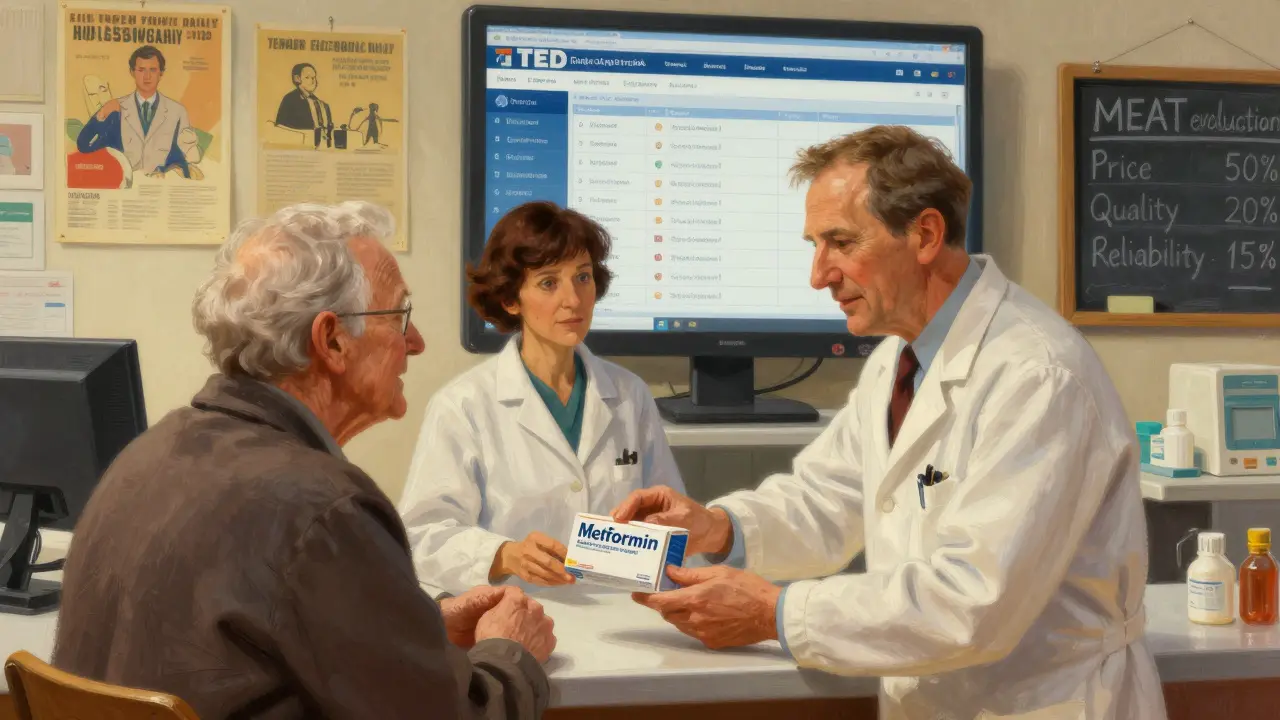
When a hospital needs to buy 100,000 packs of generic metformin, they don’t just call their usual supplier. They launch a formal tender. This means publishing a contract notice in the Tenders Electronic Daily (TED), the EU’s official online portal. Any company in the EU-whether based in Sweden or Slovenia-can respond. The system is built so that a small Polish manufacturer has the same shot at winning the contract as a multinational pharmaceutical giant.
The most common method used is the Open procedure. Any supplier can submit a bid without being pre-vetted. This creates intense competition, especially for high-volume generics. In 2022, about 45% of all EU public tenders used this method. For generics, it’s the norm. The result? Prices for common drugs like paracetamol or atorvastatin dropped by up to 70% over the last decade in countries with strong tendering systems.
The MEAT Rule: Why Lowest Price Isn’t Always Best
Here’s where Europe’s system diverges sharply from places that just pick the cheapest bid. The EU requires the use of Most Economically Advantageous Tender (MEAT) for most healthcare procurements. That means evaluating bids on more than just cost.
Under MEAT, authorities assign weights to different factors. For example, a tender for generic insulin might score bids like this:
- Price: 50%
- Quality certification (GMP, ISO): 20%
- Supply reliability (on-time delivery history): 15%
- Environmental impact (packaging, carbon footprint): 10%
- Local production or EU-based manufacturing: 5%
This isn’t theoretical. A 2023 benchmarking study by the European Public Procurement Observatory found that health authorities using MEAT saw 15.7% more innovation in their drug supply chains-like better blister packs, child-safe packaging, or digital tracking for counterfeit prevention.
Professor Anna De Lillo from Bocconi University found that MEAT-based tenders delivered 12-18% better long-term value than lowest-price-only contracts for medicines. Why? Because the cheapest pill might come from a supplier with a 30% late delivery rate. That’s not savings-that’s risk to patient care.
Framework Agreements: The Hidden Backbone of Generic Supply
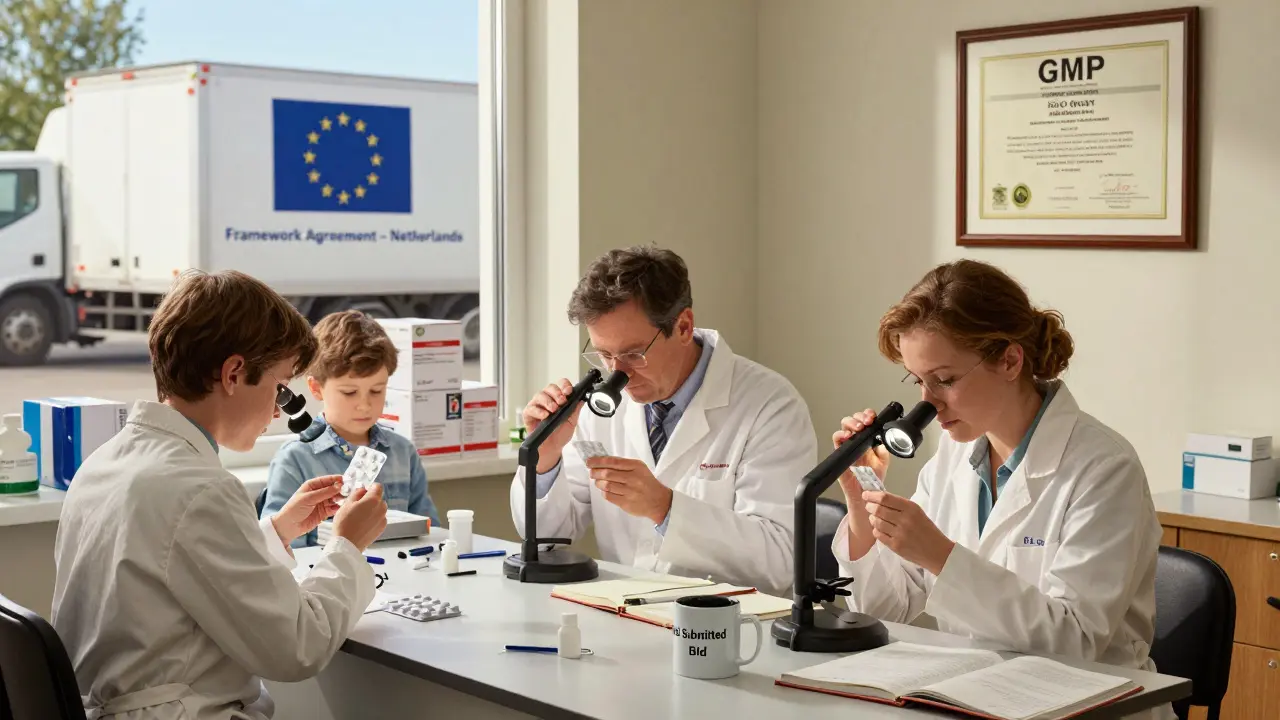
Most public health systems don’t buy drugs one-off. They need them every month. That’s where Framework Agreements come in. These are pre-negotiated contracts with one or more suppliers, valid for up to four years. Once signed, individual hospitals can place "mini-tenders" under the framework without restarting the full tender process.
Multi-supplier frameworks are the gold standard. For example, the Dutch Ministry of Health might sign a framework with five generic manufacturers for metformin. Each quarter, hospitals choose from those five based on current price and delivery terms. This keeps competition alive even after the main contract is awarded.
But there’s a catch. A 2023 survey by Eurochambres found that 31% of small generic drug makers spent over 100 hours just to qualify for a single framework. One French SME, after qualifying for a €200,000 framework, received only two mini-tenders in 18 months. "It was like paying a membership fee for a club that rarely calls," said Sophie Laurent, the owner.
Still, for larger suppliers, it’s a game-changer. German company Markus Weber said winning a framework with Deutsche Bahn (a major public buyer) cut his bidding costs by 60%. Predictable volume means better planning, lower overhead, and lower prices for buyers.
Electronic Systems and the Push for Simplicity
Ten years ago, submitting a tender meant printing 50 pages, signing them, and mailing them by courier. Today, nearly 76% of EU public tenders are done electronically. The European Single Procurement Document (ESPD), launched in 2023, lets suppliers declare their eligibility with a simple online form-no notarized bank statements or tax certificates needed unless requested later.
This has cut administrative time by 40% for businesses. But not all countries are equal. Nordic nations like Denmark and Finland have digital platforms rated 4.6 out of 5 for usability. In some Eastern European countries, the same portals score as low as 2.8. The result? Cross-border participation in healthcare tenders remains low-only 7.3% of total value comes from suppliers outside the buyer’s country.
Experts point to language barriers and inconsistent rules as the main blockers. A Spanish supplier might understand the technical specs but struggle with the Czech version of the tender documents. The EU is pushing for standardized templates and AI-assisted translation tools to fix this by 2027.
Challenges and Criticisms
Despite its strengths, the system isn’t perfect. A 2023 report by the European Court of Auditors found that 37% of Competitive Dialogue procedures-used for complex or innovative drugs-lacked proper documentation. One case in Spain involved a €180 million rail signaling contract that was canceled after 18 months because the technical specs were too vague. The same risk exists in healthcare. If a tender asks for "high-quality packaging" without defining it, suppliers guess. That leads to disputes, delays, and legal challenges.
Another issue: proportionality. EU rules say you can’t require a supplier to have €10 million in annual revenue to bid on a €500,000 drug contract. But in practice, some public buyers still do. Small and medium-sized generic manufacturers say this keeps them out. The European Commission’s 2022 survey found that 41% of SMEs abandoned tender opportunities because the paperwork was too heavy.
And then there’s the slow adoption of sustainability. While 68% of high-value tenders now include environmental criteria, most still focus on paperless submissions or energy use in warehouses. Few require biodegradable packaging or carbon-neutral logistics for drug shipments. That’s changing. By 2025, 85% of high-value medicine tenders are expected to include sustainability metrics.
What Works Best: Lessons from the Frontlines
The Finnish Innovation Fund’s 2022 tender for smart grid technology used a Competitive Dialogue process to co-develop a solution with suppliers. The result? 32% cost savings and a 14-month faster rollout. Health systems are starting to copy this.
One Dutch regional health authority began holding pre-tender market consultations with generic drug makers before launching a tender for antibiotics. They asked: "What’s holding you back? What specs are unclear?" The feedback led to clearer technical requirements. Bid challenges dropped by 34%. The whole process finished 22% faster.
Successful bidders all say the same thing: read the evaluation criteria carefully. Don’t just focus on price. If quality gets 30% weight, show your quality control logs. If delivery reliability matters, include your on-time delivery rate for the last 12 months. One UK-based generic supplier said their win rate jumped from 12% to 41% after they started attaching a simple one-page performance summary to every bid.
And don’t underestimate the power of certification. Suppliers with ISO 13485 (medical device quality) or GMP (Good Manufacturing Practice) certification are 28% more likely to win, according to the Chartered Institute of Procurement & Supply.
The Future: AI, Sustainability, and Fairness
The next five years will bring big changes. The EU’s "Digital Europe Procurement Accelerator" aims for 95% electronic tendering by 2027. AI tools are already being piloted in France and Finland to score bids automatically. Early results show 30% faster evaluations with 99.2% consistency-no human bias, no fatigue.
Sustainability will become non-negotiable. By 2028, 75% of high-value medicine tenders will include circular economy rules: reusable containers, minimal plastic, returnable packaging. Some countries are even testing "carbon scoring" for drug shipments.
But the biggest challenge remains: making the system work for everyone. Right now, large suppliers dominate because they have legal teams and procurement departments. The EU is responding with new training programs for small businesses and simplified tender templates for medicines under €250,000.
Europe’s tendering system isn’t perfect-but it’s the most transparent, rules-based approach to generic drug purchasing in the world. It doesn’t just lower prices. It ensures quality, reliability, and fairness. And for patients, that’s what matters most.
How does the EU ensure fair competition in generic drug tenders?
The EU requires all public tenders above certain thresholds to be published in the Tenders Electronic Daily (TED), allowing any supplier from any member state to bid. Rules prohibit discriminatory criteria-like requiring excessive revenue or local presence-and mandate transparent evaluation using MEAT (Most Economically Advantageous Tender). Independent oversight and legal challenges through the European Court of Justice further enforce fairness.
Why do some generic drug suppliers fail to win EU tenders?
Many fail because they focus only on price and ignore other evaluation criteria like quality certifications, delivery reliability, or environmental impact. Others miss deadlines, misclassify products using CPV codes, or submit incomplete documentation. Small suppliers often underestimate the administrative burden-some spend over 100 hours per tender without winning.
What is the difference between Open and Restricted tendering procedures?
In an Open procedure, any supplier can submit a full bid without prior screening. It’s the most competitive but creates high administrative work for the buyer. In a Restricted procedure, suppliers first apply to be shortlisted. Only those approved can submit a full tender. It reduces workload but can exclude new or smaller players who don’t have the track record to pass pre-qualification.
Can a small company from Romania win a tender in Germany?
Yes, absolutely. EU law forbids discrimination based on nationality. A Romanian generic drug maker has the same legal right to bid as a German one. The challenge isn’t legality-it’s practical: language, understanding local requirements, and navigating digital portals. Many small firms succeed by partnering with local distributors or using translation services.
How do sustainability criteria affect generic drug tenders?
Sustainability is now a formal scoring factor in most high-value tenders. Buyers may award points for recyclable packaging, low-carbon logistics, or energy-efficient manufacturing. While it doesn’t always lower the price, it reduces long-term environmental costs and aligns with EU Green Deal goals. By 2025, 85% of tenders over €1 million will include sustainability as a mandatory criterion.

Elen Pihlap
7 January 2026this system is so broken i cant even
Sai Ganesh
8 January 2026India has been doing something similar for years with bulk drug procurement through central agencies. The difference? We don't have 10-page forms for a ₹5000 order. Simplicity works. The EU's structure is impressive on paper but the friction kills small players. Not all innovation comes from bureaucracy.
steve rumsford
8 January 2026so like… you’re telling me the whole EU is just one giant Costco for pills now? 😅
no more random pharmacy deals? no more ‘hey my cousin works at the lab and we got a sweet discount’? i miss the chaos.
but also… 70% price drop on atorvastatin? that’s wild. i pay $40 for a 30-day supply here. in europe they pay like $3? i’m jealous.
also why does everyone care about the packaging? who gives a shit if it’s recyclable as long as the pill works? also why is carbon footprint a thing for medicine? i just want to not die.
but also also… the fact that a polish company can beat a german one? that’s actually kinda cool. america would’ve just given it to the big guy with the lobbyist.
Andrew N
8 January 2026the article mentions MEAT but ignores that it’s often manipulated. scoring weights are subjective and easily gamed. a supplier can pad their ‘quality certification’ section with irrelevant ISO stamps while having zero real track record. the 15.7% innovation claim? sourced from a think tank funded by EU procurement contractors. no peer review.
also 31% of SMEs spend 100+ hours per tender? that’s not inefficiency-that’s a tax on small business. and the ‘sustainability’ metrics? mostly performative. biodegradable blister packs? the active ingredient is still petrochemical. it’s greenwashing dressed as policy.
and the digital portals? the 2.8 usability score in eastern europe? that’s because the systems were built by German contractors who didn’t consult local pharmacists. they designed for compliance, not usability.
the real problem? the EU treats procurement like a legal exam, not a supply chain. you win by paperwork, not by value.
Poppy Newman
10 January 2026OMG this is so fascinating 😍
so like… the MEAT system is basically like dating profiles where you don’t just pick the hottest person but the one who’s also kind, pays their bills on time, and doesn’t litter? 🤯
and the framework agreements? that’s like being in a group chat where the admin already picked the best pizza places and you just order from them every week??
also the ESPD? YES PLEASE. i hate paperwork. i once spent 3 hours trying to prove i had a bank account. why do we still do this in 2025??
and the carbon scoring?? i didn’t even know medicine had a carbon footprint 😭 i thought it was just pills in a box. now i’m obsessed.
can someone make a TikTok about this? i’d watch it every day.
Anthony Capunong
11 January 2026why is america the only country that lets drug companies charge whatever they want? this is why europe is better. we don’t need a bunch of rich CEOs getting rich off sick people. this system makes sense. if you’re a small company in poland and you make good pills, you deserve a shot. america? you need a lawyer and a lobbyist just to say hello to a hospital.
also who cares if the packaging is green? the pill works. but i get it-europe likes to feel virtuous. fine. i’ll take the lower prices and the reliability. let them have their eco-friendly blister packs.
we need this in the u.s. stop letting pfizer and mckesson run the show.
Ayodeji Williams
12 January 2026yo this is all fine and dandy but let’s be real-nobody in africa or asia gives a damn about ted or espd. we just want pills that don’t expire in the warehouse. the whole system is built for rich countries to feel good about themselves while the rest of the world scrambles for leftovers.
and don’t get me started on ‘sustainability’-i’ve seen kids in lagos take half a pill because the other half got lost in customs because the box had the wrong label. who cares if it’s recyclable? just let the damn thing get here.
also why is everyone acting like the eu invented competition? we’ve been undercutting each other in naija for decades with no forms, no portals, no ‘evaluation criteria’-just cash and trust. sometimes that works better than a 20-page spreadsheet.
you’re all so proud of your systems but the real heroes are the guy who rides a motorbike with 5000 pills in a backpack to a village clinic. he doesn’t need a ted account.
Kamlesh Chauhan
14 January 2026fr tho why is everyone making this so complicated
just pick the cheapest and move on
all this meaT and framework and sustainability
its just a pill
people are dying waiting for paperwork to clear
who even cares about the packaging
also why are we talking about carbon footprint for medicine
its not a tesla
and the small companies spend 100 hours just to lose
thats not fair thats just cruel
and the digital portals in eastern europe
they look like they were made in 2003
why is the eu so good at making things harder