
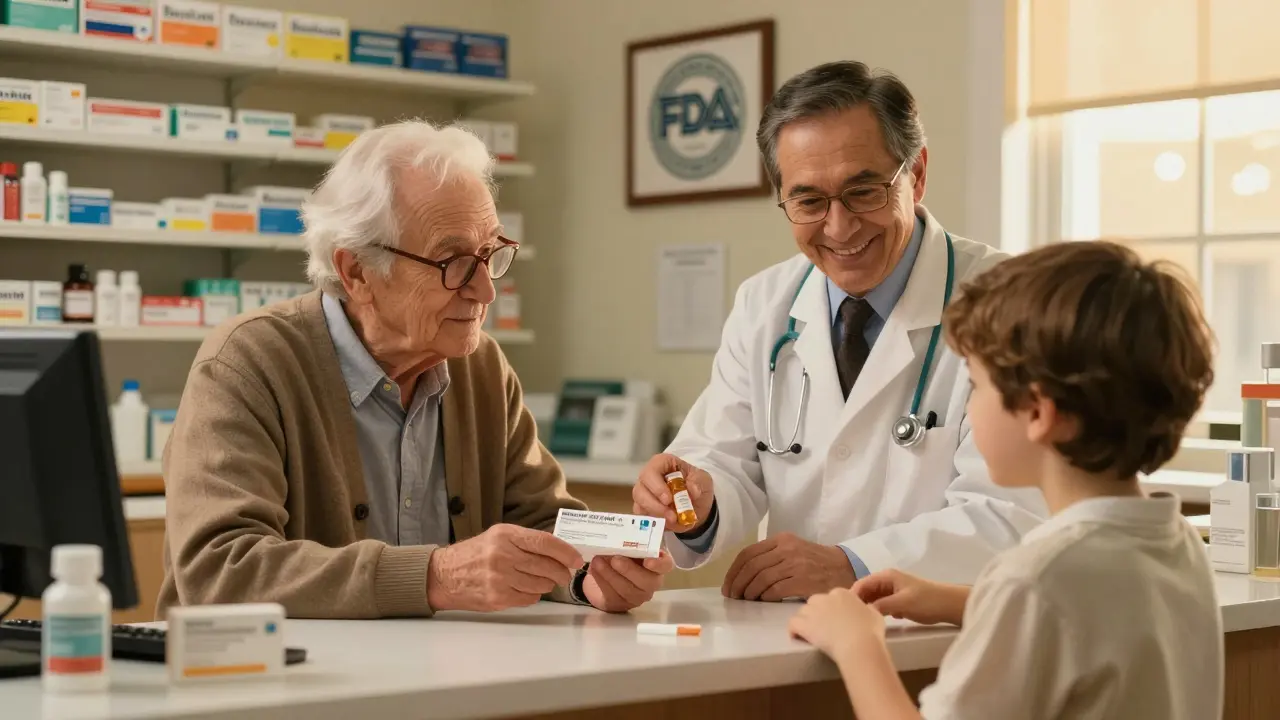

More than 90% of prescriptions filled in the U.S. are for generic drugs. Yet, nearly one in three patients still hesitate to take them-even when their doctor recommends it. Why? It’s not about cost. It’s about trust. Many patients believe generics are weaker, less safe, or somehow "second-rate." But the science says otherwise. Generic drugs must meet the same strict standards as brand-name drugs. They contain the exact same active ingredient, in the same strength, and work the same way in the body. The FDA requires them to be bioequivalent-meaning they deliver the same amount of medicine into the bloodstream within the same timeframe. So why does doubt linger? And more importantly, what can healthcare providers actually do to fix it?
Why Patients Doubt Generics-And Who’s Most Likely To
The problem isn’t universal. Research shows patient confidence in generics varies widely based on who you are. A 2024 study in PLOS ONE found that patients over 60 are more likely to trust generics than younger adults. Those with higher education and income levels also show stronger confidence. But the biggest gaps show up in marginalized groups. Non-white patients are nearly 60% more likely to believe generics are less effective than brand-name drugs. Patients with low health literacy are twice as likely to think generics are unsafe. And those on Medicaid report higher levels of skepticism than those with private insurance. It’s not just about money. Many patients fear change. One survey found that 25.7% of patients simply don’t want to switch from a brand they’ve been using for years-even if it costs three times more. Another 29.5% worry about new side effects. And a surprising number think that if a drug is cheaper, it must be lower quality. These aren’t irrational fears-they’re shaped by years of marketing, inconsistent experiences, and lack of clear communication.The Real Difference Between Brand and Generic
Let’s cut through the noise. A generic drug isn’t a copy. It’s a legal, scientifically proven equivalent. The FDA doesn’t approve generics based on trust. They require proof. Every generic must pass rigorous testing to show it delivers the same amount of medicine into the bloodstream as the brand-name version. The acceptable range? Between 80% and 125% of the brand’s performance. That’s not a guess. That’s lab data. And it’s not just about the active ingredient. Generics must match the brand in dosage form, route of administration, and stability. They’re held to the same manufacturing standards. The only differences are in the inactive ingredients-the fillers, dyes, and coatings. These don’t affect how the drug works. But they can change how the pill looks or tastes. That’s why some patients report feeling different after switching. It’s not the medicine. It’s the color, shape, or even the texture of the pill. A patient who’s taken a blue capsule for ten years might feel uneasy when handed a white tablet-even if it’s the exact same drug. That’s a perception issue, not a medical one.Who Holds the Key to Patient Trust? (Spoiler: It’s Not the Pharmacy Flyer)
You won’t fix patient doubt with a pamphlet. You won’t fix it with a website link. You won’t fix it with a quick, "It’s the same thing." The research is clear: the single biggest factor in whether a patient accepts a generic is direct, personal communication from their healthcare provider. A landmark study by Shrank and colleagues found that patients who had a conversation with their doctor or pharmacist about switching to a generic were far more likely to accept it. The difference? Patients who received a simple explanation were 21% more comfortable with substitution. Those who got no explanation? Nearly half felt uncertain. And here’s the kicker: it didn’t matter if the patient liked generics before the talk. What mattered was that someone took the time to explain. Pharmacists are especially powerful in this role. They’re often the last point of contact before the patient takes the medicine. A 2023 study showed that 84.7% of patients who received a clear explanation from their pharmacist felt comfortable with the switch. Only 63.2% of those who didn’t get any explanation felt the same. And in real-world reviews, patients praise pharmacies where staff take the time to answer questions. They complain bitterly about those that rush them through the counter.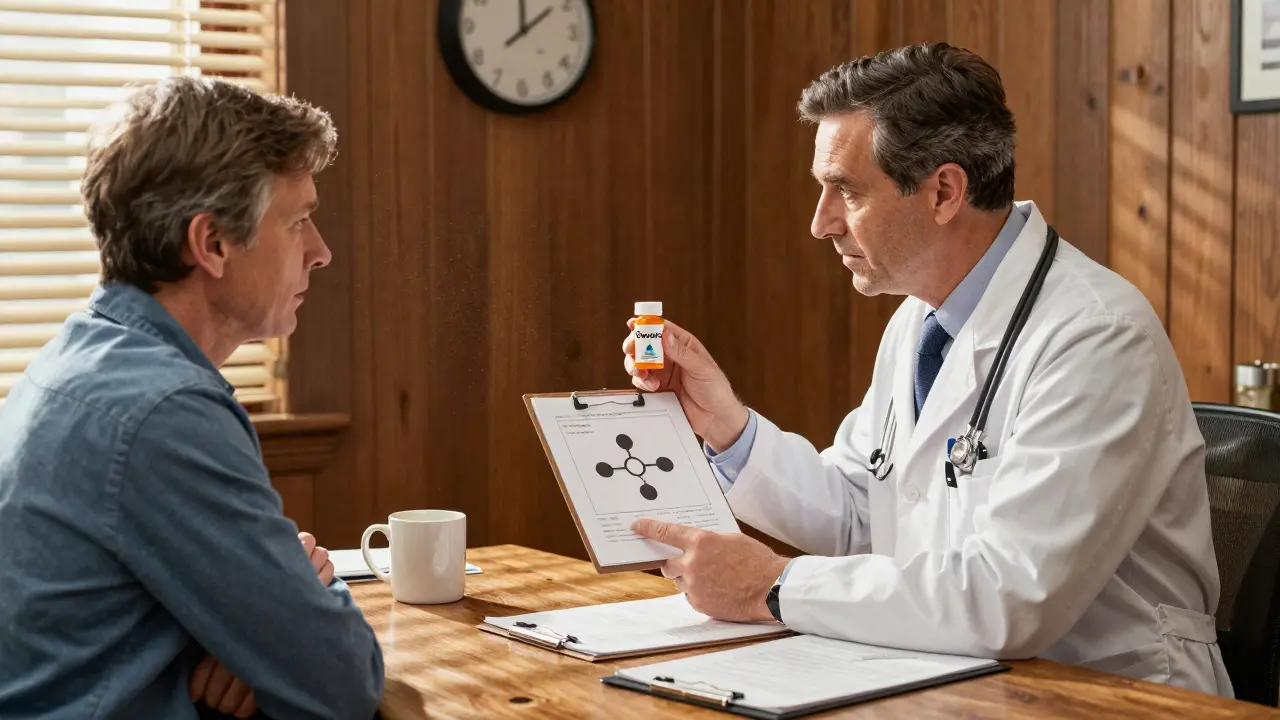
What to Say-And How to Say It
You don’t need a medical degree to explain this. You need clarity and empathy. Here’s what works:- Start with reassurance: "This generic version has been approved by the FDA to work exactly like your previous brand. The active ingredient is identical. The only difference is the price."
- Use analogies: "Think of it like buying store-brand aspirin. The active ingredient is the same as Bayer. The shape might be different, but it relieves your headache the same way."
- Address the fear of side effects: "Some people notice a change in how the pill looks or feels. That’s because the fillers are different. But the medicine inside? It’s the same. If you notice anything unusual, let us know-we’ll help you figure out if it’s the medication or something else."
- Invite questions: "What concerns do you have about switching?" Then listen. Don’t interrupt. Don’t rush. Often, the real worry isn’t about the drug-it’s about being left out of the decision.
Special Cases: Complex Medications and Mental Health Drugs
Not all generics are created equal in the patient’s mind. Drugs for epilepsy, thyroid conditions, and psychiatric illnesses like depression and anxiety trigger more hesitation. Why? Because the consequences of even a small change feel higher. A patient on Sertraline might worry that switching to a generic could make them feel "off"-and they’re not wrong to be cautious. But here’s what the data shows: in large-scale studies, there’s no consistent difference in effectiveness or side effects between brand and generic versions of antidepressants. Still, anecdotal reports exist. One Reddit thread with over 1,400 comments shared stories of patients who felt worse after switching. Some reported increased anxiety. Others felt more fatigued. Were these real side effects? Possibly. But in most cases, they were temporary, or tied to psychological expectations rather than pharmacological differences. The solution? Don’t assume. For patients on these drugs, offer a transition plan. Say: "We can start you on the generic and check in after two weeks. If you feel any change, we’ll adjust. Your comfort matters more than the cost." This gives patients control-and that’s often the missing piece.What Doesn’t Work (And Why)
Avoid these common mistakes:- "It’s the same thing." Too vague. Patients hear this and think, "If it’s the same, why is it cheaper?"
- "The insurance company made me switch." This frames the change as a corporate decision, not a medical one. It erodes trust.
- Handing over a brochure and walking away. A 2023 study found only 62% of patients found pharmacy pamphlets "somewhat helpful." Most didn’t read them at all.
- Using jargon like "bioequivalence" or "ANDA." Unless you’re explaining it in plain language, it just confuses people.

What Works: Real Examples from the Field
One clinic in Ohio started training all staff to use a simple 2-minute script every time a generic was dispensed. They didn’t just say, "This is cheaper." They said: "This is the same medicine your doctor prescribed, just without the brand name. The FDA checks it to make sure it works exactly like the brand. We’ve seen thousands of patients switch with no issues. But if you feel different, we’ll help you right away." Within six months, patient complaints about generics dropped by 41%. Refill rates for generics increased by 18%. Another pharmacy chain introduced "Generic Check-In" cards. After a patient picked up a generic, a pharmacist followed up with a quick call three days later: "Just wanted to check in-how’s the new pill working for you?" That tiny step boosted satisfaction scores by 32% and reduced returns by nearly half.Why This Matters Beyond Trust
This isn’t just about making patients feel better. It’s about saving lives and money. Generic drugs save the U.S. healthcare system over $370 billion a year. That’s money that can fund other care-screenings, mental health services, chronic disease management. But if patients refuse to take them, those savings vanish. And worse, patients might stop taking their medication altogether because they’re confused or distrustful. The goal isn’t to push generics. It’s to ensure patients can make informed choices. When they understand that a $4 generic is just as safe and effective as a $120 brand, they’re more likely to stick with their treatment. That means fewer hospital visits. Fewer complications. Better health outcomes.Final Thought: Trust Is Built One Conversation at a Time
You can’t force confidence. You can’t buy it with a campaign. You can’t fix it with a logo on a pill bottle. Real trust comes from being heard. From having your concerns taken seriously. From knowing someone took the time to explain-not just to inform, but to connect. The science is settled. The generics are safe. The savings are real. The only thing left to change is how we talk about them.Are generic drugs really as effective as brand-name drugs?
Yes. The FDA requires generic drugs to have the same active ingredient, strength, dosage form, and route of administration as the brand-name version. They must also prove bioequivalence-meaning they deliver the same amount of medicine into the bloodstream at the same rate. Thousands of studies and real-world data confirm that generics work just as well. The only differences are in inactive ingredients like color or filler, which don’t affect how the drug works.
Why do some people feel different when switching to a generic?
The active drug is the same, but the inactive ingredients-like dyes, fillers, or coatings-can differ. These can change how the pill looks, tastes, or even how quickly it dissolves in the stomach. For most people, this causes no issue. But for some, especially those sensitive to changes in medication routine, it can feel like a different drug. This is often psychological, but it’s real to the patient. The best response is to listen, acknowledge their experience, and offer to switch back if needed.
Can pharmacists substitute generics without asking the patient?
In most states, pharmacists are allowed to substitute a generic for a brand-name drug unless the doctor specifically writes "dispense as written" or the drug is on a restricted list. But just because they can doesn’t mean they should. Best practice is to always inform the patient and explain the change. Studies show patients are far more likely to accept the switch when they’re told in advance-and they’re more likely to stick with the medication if they feel involved in the decision.
Are generics safe for older adults and people with chronic conditions?
Yes. In fact, older adults are more likely to trust generics than younger patients. A 2024 study found that 71.4% of patients over 60 considered generics safe. For chronic conditions like high blood pressure, diabetes, or depression, generics are routinely used and monitored. The FDA holds them to the same quality standards as brand-name drugs. The key is ongoing communication-checking in after the switch to make sure the patient is tolerating it well.
How long should a provider spend explaining generics to a patient?
Just 2 to 3 minutes. Research shows that even a brief, clear conversation can dramatically increase acceptance. You don’t need a lecture. Focus on three things: 1) The generic is the same medicine, 2) The FDA ensures it works the same way, 3) You’re available if they have concerns. That’s enough to build trust-and it’s far more effective than any brochure or video.


Arlene Mathison
20 January 2026Look, I get why people are skeptical - I was too. But after my dad switched from brand-name blood pressure meds to generic and his numbers stayed perfect for 3 years? I stopped doubting. The science isn’t lying. It’s just not marketed with flashy ads.
Also, that Ohio clinic example? Pure gold. People don’t need pamphlets. They need a human who cares enough to say, "Hey, this is the same stuff, just cheaper. Let me know if you feel weird."
Andy Thompson
22 January 2026Generic drugs are a government scam. The FDA? Controlled by Big Pharma. Why do you think they let generics exist? So they can sell you the same pill for 1/10th the price… and still make a profit. They don’t want you to know the truth - that generics are made in the same factories, just repackaged. 💸🧪
Ever notice how every time a new generic hits the market, the brand-name version gets discontinued? Coincidence? I think not. 🤔
Emily Leigh
24 January 2026Ugh. Another ‘trust the science’ lecture. I’ve been on 4 different generics for anxiety. Three of them made me feel like a zombie. One made me cry for no reason. The brand? I felt fine. So no, I don’t care what the FDA says - my body knows better. 🤷♀️
clifford hoang
24 January 2026Let’s be real - if generics were truly identical, why do they look different? Why do they taste different? Why do they come in different shapes? 🤨
It’s not just the fillers. It’s the *energy*. You think a pill made in India has the same vibrational frequency as one made in New Jersey? Nah. The body feels it. You think your thyroid doesn’t notice the difference? It does. It’s not science. It’s spirituality. 🌿💊
Also, who funds these studies? Big Pharma? The FDA? The same people who told us cigarettes were safe. 🤫
Carolyn Rose Meszaros
25 January 2026My pharmacist actually called me after I switched to a generic antidepressant. Just a quick, "Hey, how’s it going?" That tiny thing made me feel seen. I didn’t even know I needed that.
Also - yes, the pill looks different. But I’ve been on it for 8 months and I haven’t had a panic attack. So… I’m good. 😊
Manoj Kumar Billigunta
26 January 2026In India, we use generics every day. My mother takes generic insulin for 20 years. No problem. No side effects. The doctors here don’t waste time explaining - they just say, "This is same medicine, cheaper. Take it." And people do.
Maybe in US, we overthink everything. Not everything needs a 3-minute speech. Just trust the system.
Also, if you can afford brand, good for you. But don’t shame others who need to save money.
pragya mishra
26 January 2026Why are you all acting like this is some revolutionary idea? In 2015, I told my doctor I wouldn’t take generics. He looked me dead in the eye and said, "Then I won’t prescribe you anything." I switched. I lived. I’m fine.
Stop making this a moral issue. It’s medicine. Not a cult.
sagar sanadi
28 January 2026Oh wow. Another article saying "trust the FDA". Next they’ll tell us the moon landing was real. 🤡
Generics are made in the same factories as the brand? Sure. But which factory? The one with the broken AC? The one where the guy who fills the capsules just got fired? Nah. I’ll stick with my blue pill that I’ve had since 2012. Even if it costs $120. At least I know who made it. 😏
kumar kc
28 January 2026Stop wasting time. Take the generic. It works. End of story.
Greg Robertson
29 January 2026My grandma switched to generic thyroid meds and started feeling shaky. We went back to brand. She’s been fine since. That doesn’t mean generics are bad - it just means some people’s bodies react differently. Maybe the fillers affect absorption? Who knows.
But if someone feels off? Listen to them. Don’t just say, "It’s the same." That’s not helpful. That’s dismissive.
Thomas Varner
29 January 2026I’ve been on 12 different generics for high blood pressure. Four of them made me dizzy. Two made me nauseous. One made me feel like I was underwater. The brand? Perfect. So yeah - I get why people are nervous. It’s not just "perception." It’s real, physical reactions.
And no, the FDA doesn’t test for every single person’s sensitivity. They test averages. That’s not enough.
Nadia Watson
31 January 2026As a nurse who has worked in three states, I can tell you: the single biggest factor in whether a patient accepts a generic is whether the provider looks them in the eye and says, "I’ve seen this work for hundreds of people. I trust it. Do you have questions?"
Not "It’s the same." Not a pamphlet. Not a text message.
Just a moment of human connection.
Also - I’m not a fan of emojis. But if you’re reading this, thank you for caring enough to ask.
thomas wall
1 February 2026It is deeply concerning that in a nation with the highest per-capita healthcare expenditure in the world, citizens are being steered toward pharmaceutical substitutes on the basis of cost-efficiency rather than clinical certainty.
The erosion of trust in medical institutions is not merely a symptom - it is a consequence of systemic commodification of health. When a pill’s value is reduced to its price tag, we have already lost the moral high ground.
And yet - the data remains clear. Generics are bioequivalent. The question is not whether they work - but whether we have the integrity to acknowledge it.
Courtney Carra
2 February 2026Think about it - if a generic is truly identical, why does the brand name cost 30x more? Why does the marketing team get a mansion and the generic manufacturer gets a warehouse?
It’s not about the pill. It’s about the story. The brand tells you: "You’re worth this." The generic says: "You’re worth less."
And maybe… that’s the real side effect.
Also - I don’t use emojis. But I’m not a robot. 😌
Paul Barnes
4 February 2026"The FDA requires them to be bioequivalent-meaning they deliver the same amount of medicine into the bloodstream within the same timeframe."
Correction: "within the same timeframe" is inaccurate. The acceptable range is 80-125% AUC and Cmax, which is a 45% variance. That’s not "same." It’s statistically equivalent, but not pharmacologically identical in all cases.
Also, "inactive ingredients" can alter dissolution rates, gastric pH, and even gut microbiome interactions. This isn’t just about color.
So yes - they’re close. But not identical. And dismissing patient concerns as "perception" is scientifically irresponsible.