


A detached retina isn’t something you can wait on. It’s not a minor annoyance, and it’s not something that’ll go away with rest. If you suddenly see a shower of floaters, bright flashes in your peripheral vision, or a dark curtain creeping across your sight - retinal detachment could be happening right now. And every hour matters.
The retina is the thin layer of tissue at the back of your eye that turns light into signals your brain understands. When it pulls away from its normal position, it loses its blood supply and stops working. If you don’t get it reattached quickly, permanent vision loss can happen - sometimes in just one day.
What Are the Warning Signs?
You can’t ignore these six symptoms. They don’t come on slowly. They appear suddenly, and they’re your body’s emergency alarm.
- Sudden increase in floaters - Not just one or two. Dozens of dark spots, strings, or cobwebs that appear out of nowhere. The National Eye Institute says patients often describe it as "a lot of new floaters" appearing within hours.
- Flashes of light - Like camera flashes or lightning streaks in your side vision. These aren’t caused by rubbing your eyes. They happen when the retina tugs on surrounding tissue.
- A dark shadow or curtain - This is the most urgent sign. It starts at the edge of your vision and grows, like a black curtain being pulled over your eye. If you see this, go to an eye specialist immediately.
- Blurry or distorted vision - Objects look warped, lines bend, or everything seems foggy. Cleveland Clinic data shows this happens in 68% of cases.
- Loss of peripheral vision - You can’t see things to your left or right anymore. A 2022 study found this occurs in 73% of retinal detachment cases.
- Sudden color changes - Colors look dull, washed out, or different than usual. This usually means the macula - the center of your retina responsible for sharp vision - is already affected.
These symptoms don’t always happen together. Sometimes it’s just flashes and floaters. But if you notice even one of these out of the blue, especially if you’re over 40, nearsighted, or had eye surgery before - don’t wait. Call your eye doctor right away.
How Is It Diagnosed?
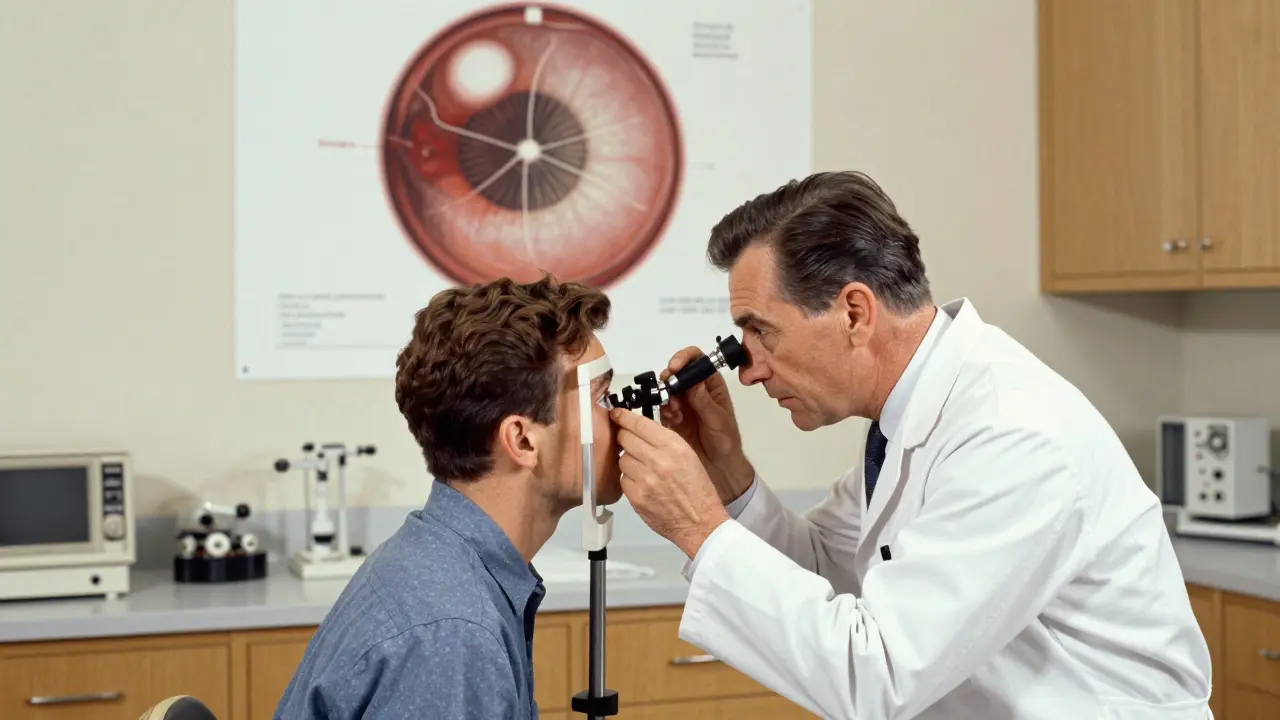
Your eye doctor won’t just look at you with a flashlight. They need specialized tools to see what’s happening behind the eye.
- Dilated fundus exam - Drops widen your pupil so the doctor can see the retina clearly using an indirect ophthalmoscope and a special lens. This is the gold standard.
- B-scan ultrasound - If your eye is cloudy from cataracts or bleeding, sound waves create a picture of the retina’s position.
- Optical coherence tomography (OCT) - This non-invasive scan gives a detailed cross-section of the retina, showing exactly where it’s detached and how much fluid is underneath.
These tools are standard in any eye clinic that handles emergencies. But not every doctor spots it. A 2022 study found general ophthalmologists miss about 22% of early cases. Retinal specialists get it right 95% of the time. That’s why timing and access matter.
Surgical Treatments: What Works and When
There are three main ways to fix a detached retina. Each has pros, cons, and specific situations where it’s the best choice.
Pneumatic Retinopexy
This is the least invasive option. A gas bubble is injected into the eye. You then position your head so the bubble floats up and presses the retina back into place. Laser or freezing treatment seals the tear.
Best for: Single, small tears on the top of the retina in people who haven’t had cataract surgery.
Success rate: 70-80%
Downsides: You have to stay in a specific position (often face-down) for days. It doesn’t work if the tear is on the bottom of the eye. About 30% of patients need a second procedure.
Scleral Buckling
A silicone band is stitched around the outside of your eyeball. It gently pushes the wall of the eye inward to meet the detached retina. The tear is sealed with freezing or laser.
Best for: Younger patients, especially those with lattice degeneration or a history of retinal tears.
Success rate: 85-90%
Downsides: Can cause nearsightedness (1.5-2.0 diopters) or double vision. It’s a more invasive surgery and requires general anesthesia.
Vitrectomy
This is the most common surgery today. The doctor removes the gel-like vitreous from inside the eye, peels off any scar tissue pulling on the retina, and then reattaches it. A gas bubble or silicone oil is injected to hold the retina in place while it heals.
Best for: Complex detachments, tears involving the macula, or cases with scar tissue or bleeding.
Success rate: 90-95%
Downsides: Almost everyone who has this surgery and still has their natural lens will develop a cataract within two years. You’ll also need to keep your head in a specific position for up to 10 days.
| Procedure | Success Rate | Best For | Recovery Time | Key Risks |
|---|---|---|---|---|
| Pneumatic Retinopexy | 70-80% | Single superior tear, phakic eyes | 1-2 weeks | 30% reoperation rate, positioning difficulty |
| Scleral Buckling | 85-90% | Youth, lattice degeneration | 2-4 weeks | Induced myopia, diplopia |
| Vitrectomy | 90-95% | Macula-off, complex tears, PVR | 4-8 weeks | Cataract (70% within 2 years), gas positioning |
There’s no one-size-fits-all. Your doctor will choose based on where the tear is, how long it’s been detached, your age, and whether you still have your natural lens.
Time Is Vision
The most critical factor in your recovery isn’t the surgery type - it’s how fast you get there.
According to a 2022 study in the Journal of VitreoRetinal Diseases, if surgery happens within 24 hours of symptoms, there’s a 90% chance the retina will stay attached. If you wait 72 hours, your chance of regaining 20/40 vision drops from 75% to 35%.
Dr. Carl Regillo, chief of retina at Wills Eye Hospital, says it plainly: "Every hour counts." Vision recovery drops about 5% per hour after symptoms start. If the macula is still attached, you have a better shot at keeping sharp central vision. Once it’s detached, the damage starts fast.
That’s why emergency protocols require evaluation within 24 hours - and same-day surgery if the macula is involved. In some top clinics, patients are seen within 4 hours and operated on within 12.
What Happens After Surgery?
Surgery isn’t the end. Recovery is just as important.
- Positioning - If you had gas injected, you must keep your head down (or in a specific position) for 50% of every 24 hours for 7-10 days. This keeps the bubble pressed against the tear. Lying on your back or sitting upright can ruin the repair.
- Activity limits - No flying, no scuba diving, and no heavy lifting for weeks. Gas expands at high altitudes and can cause dangerous pressure.
- Follow-up scans - You’ll need OCT and ultrasound checks at 1 week, 1 month, and 3 months to make sure the retina stays attached.
- Watch for complications - Cataracts, high eye pressure, and recurrent detachment are possible. Most cataracts develop within two years after vitrectomy and will need removal later.
One patient on Reddit described spending 10 days face-down, using a special pillow, and feeling like "a human pretzel." 41% of patients report serious discomfort from positioning, and 38% need help at home just to eat or shower.

Who’s at Risk?
Retinal detachment affects about 1 in 10,000 people each year. But some groups are far more at risk:
- People with severe nearsightedness (over -5.00 diopters) - 167 in 10,000 annually
- Those who’ve had cataract surgery - 0.5% to 2% risk
- People with lattice degeneration - 1% lifetime risk
- Those with a family history of detachment
- Anyone who’s had a serious eye injury
Age matters too. Risk increases sharply after 40. That’s why sudden floaters and flashes in someone over 50 are a red flag - not a normal part of aging.
What’s Next?
Technology is improving. In January 2023, the FDA approved the EVA Platform - a 27-gauge vitrectomy system that uses smaller incisions, less trauma, and faster healing. Intraoperative OCT is now helping surgeons see exactly how well the retina is reattached during surgery.
Future treatments might include bioengineered retinal patches or gene therapies that prevent detachment in high-risk people. But for now, the best tool we have is awareness.
If you’ve ever been told "it’s just floaters" and ignored it - don’t make that mistake again. Your vision isn’t something you can afford to gamble with.
Can retinal detachment heal on its own?
No. A detached retina cannot heal by itself. Without treatment, the photoreceptor cells that send visual signals to the brain die within hours to days. Once they’re gone, vision loss is permanent. Surgery is the only way to reattach the retina and preserve sight.
Is retinal detachment the same as a lazy eye?
No. A lazy eye (amblyopia) is a developmental problem where the brain ignores input from one eye, often due to misalignment or blurry vision in childhood. Retinal detachment is a physical separation of the retina from the back of the eye - a medical emergency that can happen at any age. They’re completely different conditions.
Can you prevent retinal detachment?
You can’t always prevent it, but you can reduce your risk. Regular eye exams are key - especially if you’re nearsighted, had cataract surgery, or have a family history. If you have lattice degeneration, your doctor might recommend laser treatment to strengthen weak areas. Avoiding head trauma and wearing protective eyewear during sports also helps.
How long does recovery take after surgery?
Recovery varies by procedure. Pneumatic retinopexy usually takes 1-2 weeks. Scleral buckling can take 2-4 weeks. Vitrectomy often requires 4-8 weeks. Full visual recovery may take months. The most important part is following your surgeon’s positioning instructions - skipping them can cause the surgery to fail.
Does insurance cover retinal detachment surgery?
Yes. In the U.S., Medicare and most private insurers cover all standard retinal detachment surgeries. The average cost is $3,850 for pneumatic retinopexy and $7,200 for vitrectomy. Emergency treatment is always prioritized, and delays due to cost are rare - hospitals are required to treat eye emergencies immediately.
What should I do if I notice flashes and floaters?
Call your eye doctor immediately. Don’t wait. Don’t assume it’s just aging. If you can’t get in within 24 hours, go to an emergency room or urgent eye clinic. If you also have a dark curtain over your vision, treat it like a stroke - time is critical. Early treatment saves vision.




Roshan Gudhe
5 February 2026It’s wild how something so invisible can destroy your world in hours. I’ve seen friends brush off floaters like it’s just tired eyes - until it wasn’t. One minute they’re reading, the next they’re in surgery. This post is a lifeline for people who don’t know what they’re seeing. Thanks for laying it out like this.
Joy Johnston
5 February 2026My mom had a retinal detachment last year. She was terrified, but the surgeon did pneumatic retinopexy and she’s been fine since. The hardest part? Staying face-down for 10 days. She used a special pillow and watched Netflix upside down. It’s brutal, but worth it. Don’t ignore the signs - seriously.
Caleb Sutton
5 February 2026They’re hiding the real cause. It’s not just aging or injury - it’s 5G radiation weakening the retina. They don’t want you to know. That’s why they push surgery - it’s profitable. Your vision is being sold.
Jamillah Rodriguez
6 February 2026Okay but why is everyone so dramatic? I get floaters all the time. Like, I’m not running to the ER every time I see a spider.
Susheel Sharma
6 February 2026While the clinical data is robust, the emotional framing here is dangerously reductive. You’re equating medical urgency with moral obligation - ‘every hour counts’ becomes ‘you’re a bad person if you wait.’ This isn’t just medicine - it’s performative fear-mongering dressed as public service.
Rachel Kipps
7 February 2026i had this happen last year… i thought it was just my eyes tired from screen time. i waited 2 days. by the time i went in, the macula was starting to detach. i got vitrectomy and now my vision is 20/40 but its not the same. dont wait. please.
Katherine Urbahn
8 February 2026It is imperative to emphasize - and I cannot stress this enough - that any individual experiencing sudden visual anomalies must immediately cease all non-essential activities, contact an ophthalmologist without delay, and avoid self-diagnosis via Google or Reddit. The consequences of negligence are not merely tragic - they are irreversible, and statistically, they are entirely preventable.
Shelby Price
9 February 2026My cousin had this at 28. She’s super nearsighted, never had an eye exam since she was 16. Now she’s got a silicone implant and a new appreciation for regular checkups. I made my whole family book eye appointments after this. Seriously - if you’re over 40 or have a prescription over -5, just go. It’s 15 minutes.
Lorena Druetta
10 February 2026You are not alone. I’ve been there. I cried in the waiting room. But you can beat this. Your eyes are strong. Trust your doctor. Stay in position. Breathe. You’ve got this. I’m rooting for you.
Zachary French
11 February 2026Let’s be real - vitrectomy is a $7k scam. The docs just wanna replace your lens with a fake one and charge you $3k for cataract surgery two years later. They’ll tell you it’s ‘standard care’ - but I’ve seen the paperwork. It’s all about the insurance payouts. And don’t even get me started on the gas bubble torture.
Janice Williams
12 February 2026While the article is technically accurate, it fails to address the systemic failure of primary care physicians who routinely dismiss these symptoms as ‘age-related’ or ‘anxiety.’ The real crisis isn’t the detachment - it’s the medical system that normalizes vision loss until it’s too late. This is preventable neglect, not bad luck.
Jesse Naidoo
13 February 2026Wait - so if I have floaters and I’m nearsighted, does that mean I’m one bad cough away from going blind? Like, if I sneeze too hard, am I risking my vision? Because now I’m terrified to even breathe.
Sherman Lee
15 February 202695% success rate? That’s what they tell you. But what about the 5% who end up with double vision, chronic pain, and a gas bubble that won’t dissipate for 6 months? They don’t show you those stories. They just sell you the miracle. And then you’re stuck paying for a second surgery - while they get paid twice.
Kunal Kaushik
16 February 2026My dad had this in India. He went to a small clinic, got diagnosed with ultrasound, had scleral buckling - no fancy OCT, no fancy hospital. He’s fine now. Don’t think you need a big city hospital. Just don’t wait. Even in a small town, if you ask for a retina check, they’ll do it. Just go.