


When a standard pill doesn’t fit your body, what do you do? For millions of people, the answer isn’t switching brands or adjusting dosage-it’s turning to compounded medications. These aren’t mass-produced drugs you pick up at any pharmacy. They’re made from scratch, one patient at a time, by pharmacists who mix ingredients to match exactly what your body needs.
Why Standard Pills Don’t Always Work
Most medications you’ve seen come in fixed doses: 10mg, 25mg, 50mg. But what if you need 15mg? Or you’re allergic to the dye in the capsule? Or you can’t swallow pills because of a medical condition? These aren’t rare problems. About 15 million Americans have allergies to common fillers like lactose, gluten, or artificial colors in commercial drugs. And up to 80% of children, plus 40% of adults, struggle to swallow tablets or capsules. That’s where compounding steps in. A compounding pharmacist can remove the allergen, change the form to a liquid or cream, or create a custom dose that’s not available anywhere else. For example, a child with ADHD who refuses to take a bitter pill might thrive on a cherry-flavored liquid made just for them. One parent on Reddit shared that their child’s adherence jumped from 40% to 95% after switching to a compounded version.What Compounded Medications Can Do
Compounding isn’t magic-it’s science. Pharmacists use precise tools and sterile environments to build formulas that meet specific needs. Here’s what they can do:- Create exact doses: Need 1.5mg of a medication when only 1mg and 2mg are sold? They can make it.
- Change the form: Turn a pill into a topical gel, a suppository, or a flavored syrup.
- Remove allergens: Strip out dyes, preservatives, gluten, or lactose.
- Combine multiple drugs: Instead of taking five pills a day, get one capsule with all your meds mixed in.
- Customize for age: Elderly patients with digestion issues can get hormones delivered through the skin via a cream instead of an oral tablet.
The Hidden Risks
But here’s the catch: compounded medications are not FDA-approved. That means the agency doesn’t test them for safety, strength, or purity before they reach you. Unlike commercial drugs that go through years of clinical trials, compounded formulas are made on-site, often without the same level of quality control. This isn’t just a technicality-it’s a real danger. Between 2010 and 2020, compounded drugs accounted for just 1% of all prescriptions but 17% of drug recalls. The worst case? The 2012 meningitis outbreak linked to contaminated steroid injections from a compounding pharmacy. It killed 64 people and sickened nearly 800. That tragedy changed everything. Now, there are two types of compounding pharmacies: traditional (503A) and outsourcing facilities (503B). Traditional ones follow state rules and make small batches for individual patients. Outsourcing facilities are regulated by the FDA, follow manufacturing standards, and can ship in bulk-but only if they register and meet strict requirements. As of 2023, only about 350 of the 7,500 compounding pharmacies in the U.S. are FDA-registered 503B facilities.
Who Should Use Them?
Compounding isn’t for everyone. It’s meant for situations where no FDA-approved drug works. Experts agree: it should be the exception, not the rule. Good candidates include:- Pediatric patients who can’t swallow pills or need flavoring
- Patients with severe allergies to commercial drug fillers
- People needing unique dosages not available on the market
- Those with absorption issues (like elderly patients or people with Crohn’s disease)
- Patients on complex regimens who’d benefit from a single combined dose
- People who just want a cheaper version of a brand-name drug
- Those seeking unproven treatments like “bioidentical hormone creams” marketed as miracle cures
- Anyone using compounded versions of FDA-approved drugs that are readily available (like compounded semaglutide for weight loss-something the FDA has cracked down on)
How to Find a Safe Compounding Pharmacy
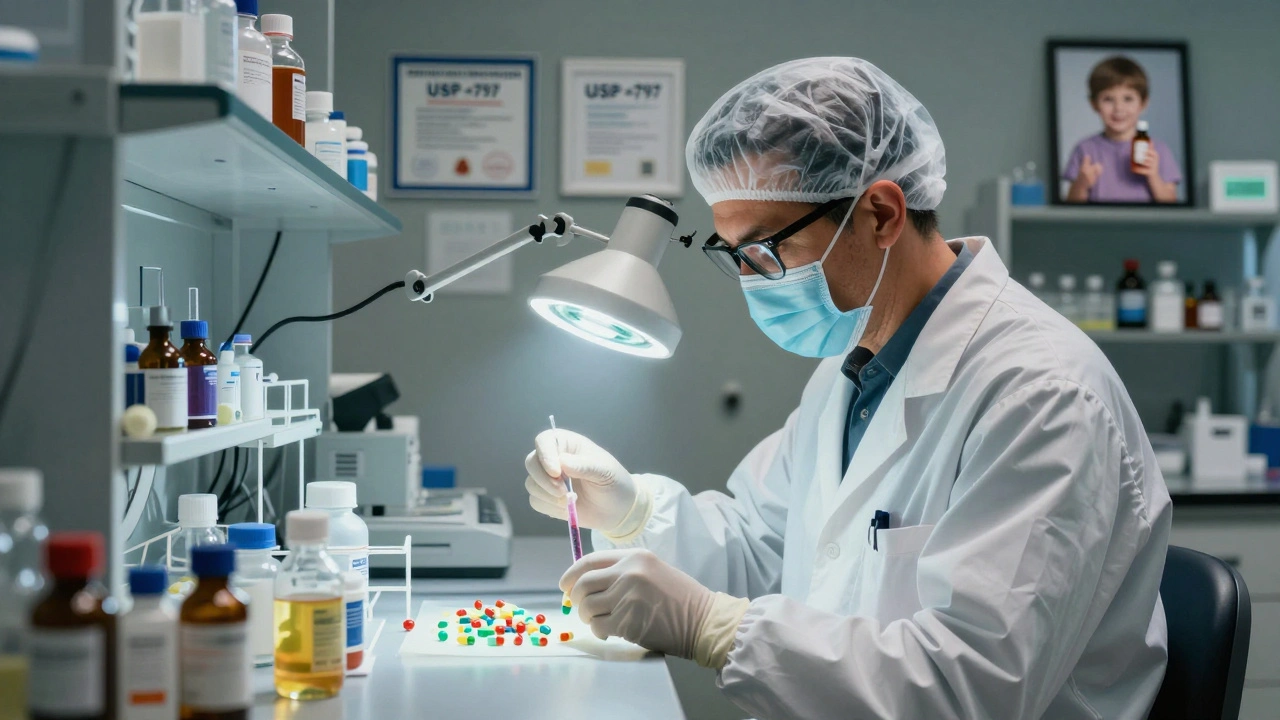
Not all compounding pharmacies are equal. The difference between a safe pharmacy and a risky one often comes down to accreditation. Look for the Pharmacy Compounding Accreditation Board (PCAB) seal. Only about 350 out of 7,500 U.S. compounding pharmacies have this credential. PCAB-accredited pharmacies follow strict standards for cleanliness, staff training, equipment calibration, and testing. They’re audited annually. If a pharmacy doesn’t mention PCAB accreditation, ask why. Also check:- Is the pharmacist licensed and experienced in compounding?
- Do they use USP Chapter <795> (for non-sterile) or <797> (for sterile) standards?
- Do they test potency and purity of each batch?
Cost and Insurance
Compounded meds cost more. A basic non-sterile compound might run $30-$100, compared to $10-$50 for a generic pill. Sterile injections or complex formulas can hit $200-$500. Insurance coverage is spotty. Medicare Part D covers only 42% of compounded claims, while private insurers vary widely. Some require prior authorization. Always check with your insurer before filling a compounded prescription.What to Do If Something Feels Off
One patient on PatientsLikeMe reported that their compounded thyroid medication caused wild swings in their TSH levels-because the dose wasn’t consistent between batches. That’s not normal. If your symptoms worsen, or you notice changes in color, smell, or texture of your medication, stop taking it and call your pharmacist immediately. Ask: “Was this batch tested for potency?” “Is this pharmacy PCAB-accredited?” “Can I see the certificate of analysis?” If you’re not getting clear answers, find another pharmacy. Your health isn’t worth the risk.The Future of Personalized Medicine
The field is evolving. Some pharmacies are starting to use genetic testing to tailor medications even further-like adjusting doses based on how fast your body metabolizes drugs. Early results show 30% better outcomes in patients with specific gene variants. But this is still experimental. The bigger question is regulation. The FDA is stepping up inspections and issuing warning letters for improper sterilization and mislabeling. New laws require 503B facilities to report adverse events and track every batch. That’s good news. But the goal isn’t to eliminate compounding-it’s to protect it. Compounding fills real gaps. For a child who can’t swallow pills, for a cancer patient who needs a flavor-free liquid, for an elderly person with multiple allergies-it’s life-changing. The key is knowing when it’s necessary, and how to find a pharmacy that does it right.Are compounded medications FDA-approved?
No. Compounded medications are not FDA-approved. The FDA does not review them for safety, effectiveness, or quality before they’re made. This is different from mass-produced drugs, which go through years of testing. Compounding pharmacies must follow state and federal guidelines, but they don’t undergo the same pre-market review.
Can I get compounded medications without a prescription?
No. Federal law requires a valid prescription from a licensed provider-like a doctor, nurse practitioner, or physician assistant-for any compounded medication. Pharmacies cannot legally compound drugs without one. If a pharmacy offers compounded meds without a prescription, it’s breaking the law and should be avoided.
How do I know if my compounding pharmacy is safe?
Look for PCAB accreditation-the gold standard. Only about 350 out of 7,500 U.S. compounding pharmacies have it. Ask if they follow USP <795> or <797> standards, if they test each batch for potency, and if they’re registered as a 503B outsourcing facility if they ship across state lines. Check their website, call them, and don’t be shy about asking for documentation.
Why are compounded medications so expensive?
They’re made by hand, in small batches, with specialized equipment and trained staff. Sterile compounds require clean rooms, air filtration, and rigorous testing-all costly. A basic non-sterile compound might cost $30-$100, while sterile injections can run $200-$500. Compare that to a $10 generic pill, and the difference is clear. Insurance often doesn’t cover them fully, so out-of-pocket costs can be high.
Can compounded medications replace FDA-approved drugs?
No-not when the FDA-approved version is available and appropriate. Compounding is meant for cases where no commercial option works: allergies, unique dosing, or inability to take standard forms. Using compounded versions of drugs like semaglutide just to avoid cost or get a different form is risky and against FDA guidance. The agency has cracked down on pharmacies doing this.


Shofner Lehto
4 December 2025My niece has a severe gluten allergy and couldn't take any ADHD meds until her pharmacist compounded a liquid version without fillers. She went from crying every morning to asking for her medicine like it was candy. This isn't niche-it's essential for families like ours.
Yasmine Hajar
5 December 2025I used to think compounding was just for weirdo alt-health folks until my dad got his chemo meds in a flavored gel after vomiting every oral dose. He said it was the first time in months he didn't feel like he was being poisoned. I wish more doctors knew about this.
Karl Barrett
6 December 2025The pharmacoeconomic implications of compounding are profoundly underappreciated. When we consider bioavailability variance in patients with compromised GI function, the utility of transdermal or sublingual formulations transcends mere convenience-it becomes a matter of pharmacokinetic optimization. The FDA’s regulatory gap here isn't negligence; it's structural. We've outsourced individualized care to a fragmented, underfunded sector because the system incentivizes mass production over precision.
Jake Deeds
6 December 2025Oh wow, so now we're glorifying pharmacies that play God with untested chemicals? I mean, sure, your kid likes cherry flavor-but what if the batch is contaminated? The 2012 outbreak wasn't an anomaly, it was a warning. People think they're being clever by avoiding big pharma, but they're just gambling with their lives. And don't even get me started on those ‘bioidentical hormone’ scams. 🙄
val kendra
7 December 2025PCAB accreditation is non-negotiable. If your pharmacy doesn't have it, walk out. I've seen too many people get sick because they trusted a guy in a lab coat with no oversight. Also-ask for the COA. Every time. No excuses.
George Graham
8 December 2025My mom's on 7 meds. The compounding pharmacy made her one capsule with all of them, minus the lactose and dyes she's allergic to. She hasn't had a stomach flare-up in two years. It's not magic. It's just good pharmacy. Why isn't this standard?
John Filby
8 December 2025Just had my first compounded thyroid med. Took me 3 months to find a pharmacy that tested batches. My TSH finally stabilized. I cried. Also, they added a little vanilla flavor to the liquid because I hate the taste. Small thing, huge difference. 🙏
Jenny Rogers
9 December 2025It is a fundamental failure of modern medicine that individualized therapeutic regimens must be procured through a clandestine, unregulated, and statistically hazardous underground of pharmaceutical artisans. The very premise that a patient's physiological uniqueness necessitates bespoke pharmaceutical preparation speaks to the profound inadequacy of the pharmaceutical-industrial complex. One must ask: if the body is not a machine to be standardized, why do we insist on mass-produced pharmaceuticals as the only legitimate modality?
Rachel Bonaparte
10 December 2025Let me tell you what they don't want you to know. The FDA doesn't regulate compounding because they're in bed with Big Pharma. Those 503B facilities? They're owned by the same corporations that make the original drugs. They let a few ‘safe’ ones operate so they can control the narrative. Meanwhile, real independent pharmacies get shut down for doing exactly what they're supposed to do-helping people. The 2012 outbreak? A setup. They needed an excuse to crush the competition. You think that’s conspiracy? Look at the stock prices after the crackdown. 🤫
Chase Brittingham
11 December 2025My dog’s on compounded gabapentin because the pills were too big and she’d spit them out. Now she gets it in peanut butter paste. She’s happier. The vet said it’s way safer than trying to crush pills. I wish more pet owners knew this was an option.
Bill Wolfe
12 December 2025Let’s be real-most people who use compounded meds are either too lazy to swallow pills or want to avoid insurance. And don’t even get me started on the ‘bio-identical hormone cream’ crowd. They’re not healing-they’re chasing vibes. You don’t need a pharmacist to mix your estrogen. You need a therapist. And yes, I’ve seen the receipts. I’ve seen the before-and-after selfies. It’s not medicine. It’s TikTok therapy with a prescription pad.
Benjamin Sedler
12 December 2025Compounding is just the tip of the iceberg. What about when your body rejects *all* synthetic molecules? That's when you start looking at plant-based, homeopathic, or even IV nutrient cocktails. People think this is fringe-but what if the future of medicine isn't pills at all? What if it's personalized biochemistry delivered through nano-suspensions or transdermal patches designed by AI? We're already there. The FDA just hasn't caught up because they're still using 1980s software.