

Antibiotic-Dairy Interaction Calculator
Check Your Antibiotic Safety
Not all antibiotics interact with dairy. This tool helps you determine if your medication is affected by calcium and how long you should wait.
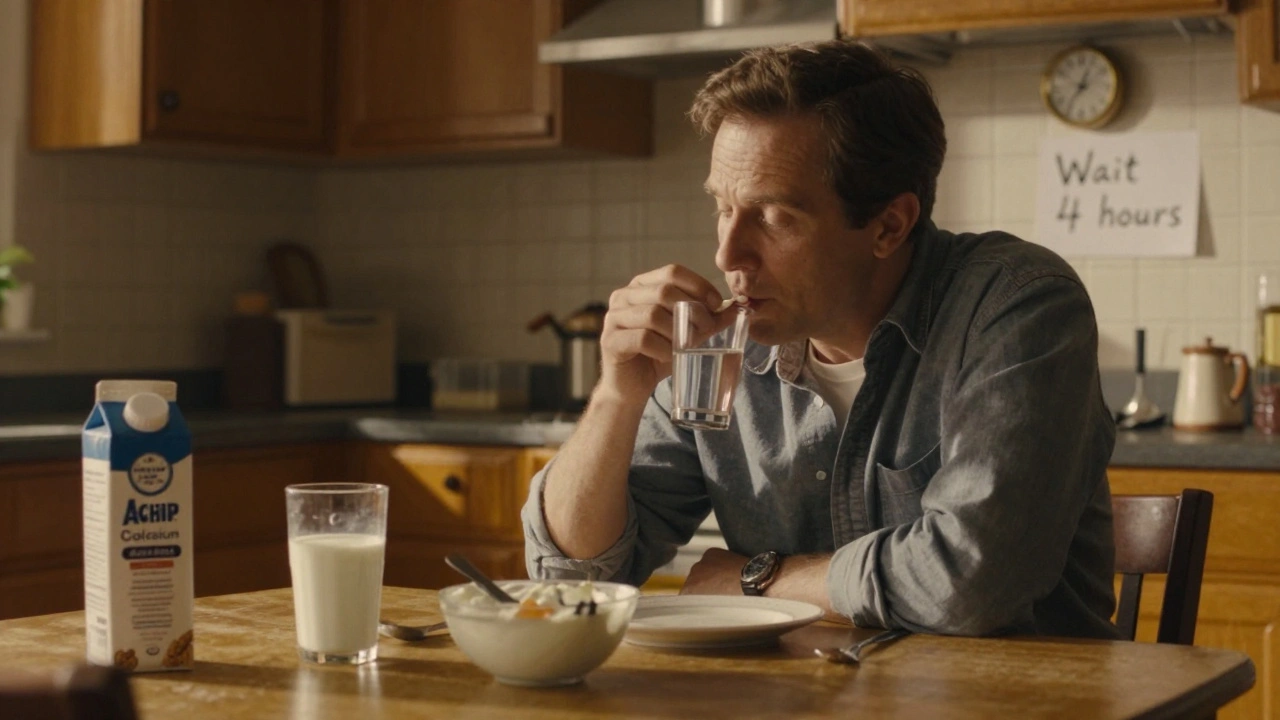
It’s a simple morning routine: coffee with milk, toast with butter, maybe a yogurt on the side. But if you’re on antibiotics like doxycycline or ciprofloxacin, that routine could be quietly sabotaging your treatment. You take your pill, you grab your cereal bowl, and you have no idea you’ve just cut your medicine’s effectiveness in half. This isn’t a myth. It’s a well-documented, clinically proven interaction that affects millions of people every year-and most don’t even know it’s happening.
Why Dairy Interferes with Certain Antibiotics
The problem isn’t milk itself. It’s the calcium. When you swallow an antibiotic like tetracycline, doxycycline, or ciprofloxacin, the calcium in dairy products binds to the drug molecules in your stomach and intestines. This creates a chemical lock called a chelate-a big, heavy, insoluble compound that your body can’t absorb. The antibiotic sits there, useless, while the infection keeps spreading. This isn’t a minor issue. Studies show that drinking milk with tetracycline can reduce absorption by 20% to 75%. With yogurt, it’s even worse-up to 92% less drug gets into your bloodstream. That’s not just a small drop. That’s the difference between your body fighting off the infection and letting it win. The science behind this goes back to the 1950s, when doctors first noticed patients on tetracycline weren’t getting better. Turns out, they were taking it with milk. Since then, dozens of clinical trials have confirmed it. The calcium in dairy doesn’t just slow absorption-it blocks it completely for hours.Which Antibiotics Are Affected?
Not all antibiotics react the same way. Some are barely touched by dairy. Others? They’re completely vulnerable. Tetracyclines are the worst offenders. That includes tetracycline itself, doxycycline, and minocycline. These drugs have a chemical structure that grabs onto calcium like a magnet. Even a small glass of milk can cut their effectiveness by half. Doxycycline is a little more forgiving than older tetracyclines, but still not safe with dairy. Fluoroquinolones like ciprofloxacin and levofloxacin are next in line. Ciprofloxacin loses up to 70% of its potency with milk and 92% with yogurt. That’s why doctors warn you not to take it with milk, cheese, or even calcium-fortified orange juice. Beta-lactams like penicillin and amoxicillin? Most of them are fine. You can take amoxicillin with breakfast without worry. But some cephalosporins-like cefalexin-do interact. So don’t assume all antibiotics are safe just because your last one was. The rule of thumb? If your antibiotic is a tetracycline or fluoroquinolone, treat dairy like poison for the next few hours.How Long Should You Wait?
Timing isn’t just important-it’s exact. For tetracyclines, you need to wait at least 2 hours before eating dairy and 4 hours after. That’s because these drugs get absorbed quickly in the upper gut, and calcium sticks around longer. If you take your pill at 7 a.m., don’t have milk until 11 a.m. If you take it at night, skip your bedtime yogurt until the next morning. For fluoroquinolones, the window is tighter: 2 hours before or after. So if you take ciprofloxacin at 8 a.m., avoid dairy until 10 a.m. and don’t have cheese with your lunch until after 10 p.m. What counts as dairy? Everything. Milk, yogurt, cheese, ice cream, butter, cream, cottage cheese, whey protein, even some protein shakes. And it’s not just cow’s milk. Goat’s milk, almond milk with added calcium, soy milk with calcium carbonate-all of it triggers the same reaction. The magic number? 200 mg of calcium. That’s about 6 ounces of milk. One small cup of yogurt can hit that. So even if you think you’re being careful, you might not be.
What About Other Calcium Sources?
You might think, “I don’t drink milk, so I’m fine.” But calcium isn’t just in dairy. It’s in antacids like Tums, calcium supplements, fortified cereals, plant-based milks, and even some mineral waters. Taking a Tums with your doxycycline? That’s just as bad as drinking milk. Same with a calcium pill at lunch if you took your antibiotic at breakfast. These aren’t edge cases-they’re common mistakes. The same 2- to 4-hour rule applies. If you’re on a tetracycline or fluoroquinolone, avoid all calcium-containing products during that window. That includes vitamins, supplements, and even some over-the-counter heartburn meds.Why This Matters Beyond Just “It Doesn’t Work”
You might think, “So what? I’ll just take another pill.” But that’s not how antibiotics work. When you don’t get the full dose, the bacteria don’t die. They survive. And the ones that survive are the strongest. They mutate. They adapt. And now they’re resistant to that antibiotic. That’s how superbugs form. The World Health Organization calls antibiotic resistance one of the biggest threats to global health. In 2021, over 1.27 million deaths were directly linked to resistant infections. A lot of those cases come from incomplete treatment-not because the drug failed, but because the patient didn’t get enough of it. This isn’t theoretical. A 2020 study in JAMA Internal Medicine found that 68% of patients who took tetracycline with dairy had drug levels too low to kill the infection. That’s not a coincidence. That’s a pattern.What Can You Do Instead?
You don’t have to give up dairy forever. You just need to plan. - Take your antibiotic on an empty stomach. Water is best. No coffee, no juice, no food for at least an hour before. - Wait 2-4 hours before eating dairy. Use that time for a snack that’s calcium-free: fruit, nuts, rice cakes, turkey slices. - If you take your antibiotic at night, avoid dairy at dinner. Have it at breakfast the next day. - If you’re on amoxicillin, azithromycin, or most cephalosporins? You’re safe. Enjoy your yogurt. - Check your labels. Some “dairy-free” products still have added calcium. Look for “calcium carbonate” or “tricalcium phosphate” on the ingredient list. And if you’re confused? Ask your pharmacist. They’re trained to catch these interactions. Most pharmacies now give out visual timing charts with your prescription.
What’s New in Antibiotic Design?
Pharmaceutical companies are trying to fix this. Newer versions of doxycycline, like Oracea, are designed to be taken with food-including dairy-because they’re formulated to avoid calcium binding. Sarecycline (Seysara), a newer tetracycline, shows only an 8% drop in absorption with dairy in clinical trials. But these are exceptions. Most antibiotics on the market today still have the same problem. Even if new drugs come out, the ones you’re likely prescribed now-doxycycline for acne, ciprofloxacin for UTIs-still need careful timing. The bottom line? Technology can help, but education still matters most.Real People, Real Mistakes
Patients aren’t careless. They’re confused. A 2022 survey found 63% of people taking tetracyclines got stomach upset on an empty stomach. So they took it with milk anyway. 29% did it on purpose to feel better. One Reddit user wrote: “I took doxycycline at 7 a.m., had coffee with milk at 7:30, and thought I was fine because it was just a splash. Two days later, my infection got worse.” Another said: “My doctor told me to avoid dairy. I thought that meant no cheese. I didn’t know yogurt counted. I took it with my breakfast smoothie every day.” These aren’t rare stories. They’re the norm. And they’re preventable.Final Advice: Don’t Guess. Ask.
When you get a new antibiotic prescription, don’t assume it’s safe with food. Don’t rely on memory. Don’t trust online forums. Ask your pharmacist: “Can I have dairy with this?” Write it down: “Take at 8 a.m. No dairy until 12 p.m.” Set a phone reminder. It’s not about being perfect. It’s about being informed. Because when antibiotics fail, it’s not just you who suffers. It’s everyone who might face a resistant infection next.Can I drink coffee with milk while taking antibiotics?
No, if you’re taking tetracycline or fluoroquinolone antibiotics. Even a splash of milk in your coffee can interfere with absorption. Wait at least 2 hours after taking your antibiotic before having coffee with milk. Black coffee without dairy is usually fine, but check with your pharmacist if you’re unsure.
Is almond milk safe with antibiotics?
It depends. Unsweetened, unfortified almond milk is usually safe. But most store-bought almond milk is fortified with calcium carbonate or tricalcium phosphate-ingredients that cause the same interaction as dairy milk. Always check the label. If it says “calcium added,” treat it like cow’s milk and wait 2-4 hours.
What if I accidentally take my antibiotic with dairy?
Don’t panic. Don’t double the dose. Just wait until the next scheduled time and take your pill correctly then. Taking extra medication can cause side effects without helping. The goal is to get the right dose over the full course-not to fix one mistake with another.
Do all antibiotics interact with dairy?
No. Antibiotics like amoxicillin, azithromycin, and most cephalosporins can be taken with food and dairy without issue. But tetracyclines (doxycycline, tetracycline) and fluoroquinolones (ciprofloxacin, levofloxacin) definitely do. Always check the label or ask your pharmacist to be sure.
Why does yogurt cause worse interactions than milk?
Yogurt has more bioavailable calcium and a lower pH, which helps the calcium bind more tightly to the antibiotic. It also contains live bacteria that may affect gut absorption. Studies show yogurt reduces ciprofloxacin absorption by up to 92%, compared to 70% with milk. The same applies to other dairy products with added calcium or higher concentrations.
Can I take calcium supplements with antibiotics?
No. Calcium supplements-whether tablets, chewables, or liquids-contain high doses of calcium that will block absorption of tetracyclines and fluoroquinolones. Take them at least 4 hours apart from your antibiotic. The same rule applies to iron and zinc supplements.




Katherine Chan
8 December 2025Just learned this about yogurt and doxycycline and my whole life just changed. I used to have my pill with my morning smoothie like a champ. No wonder my acne never cleared up. Thanks for the clarity!
Philippa Barraclough
8 December 2025It's fascinating how such a simple biochemical interaction-calcium chelation-has been known since the 1950s yet remains widely misunderstood by the public. The pharmaceutical industry has done little to standardize patient education around this, despite the clinical stakes. Even pharmacists sometimes fail to emphasize the distinction between dairy and fortified plant-based alternatives. The real failure isn't patient negligence; it's systemic communication breakdown.
Tim Tinh
8 December 2025bro i took my cipro with a cheese sandwich once and thought i was fine 😅 guess that’s why my UTI came back worse. never again. now i take it with water and a banana. best decision ever.
Olivia Portier
10 December 2025Thank you for writing this. I’m a nurse and I see this all the time-people taking antibiotics with milk because they think it helps with stomach upset. We need more posts like this. Please share it with your friends. This could literally save lives.
Tiffany Sowby
12 December 2025Of course it’s a problem. Americans can’t even follow basic medical advice. You take your pills wrong, you get sick. That’s not science, that’s just laziness. Why should the system fix your bad habits?
George Taylor
13 December 2025So… what you’re saying is… I can’t have my morning latte with my doxycycline? I mean, come on. That’s the only part of my day that makes sense. This is just another way medicine is trying to ruin my routine.
Stacy Tolbert
14 December 2025I took my antibiotic with almond milk because it said ‘dairy-free’ on the label. Didn’t even check the ingredients. Now I’m wondering if I just wasted two weeks of treatment. 😔
Ronald Ezamaru
15 December 2025For anyone on cipro or doxycycline: set two phone alarms. One for when you take the pill, one for when you can eat dairy again. I used to forget and now I’ve got a sticky note on my fridge. It’s not glamorous, but it works.
Asset Finance Komrade
15 December 2025One might argue that the calcium-binding phenomenon is merely a symptom of a deeper epistemological crisis in pharmacological education. We treat medicine as a set of discrete instructions rather than an integrated physiological dialogue. The body does not obey arbitrary time windows-it responds to chemical harmony. Yet we demand compliance without context. Is this truly healing, or merely control?
Ryan Brady
17 December 2025Just took my doxycycline with a protein shake. 🤡 Guess I’m a walking superbug now. 😎
Brianna Black
19 December 2025My doctor never told me about this. Neither did the pharmacist. I had to Google it after my infection didn’t go away. This post saved me from another round of antibiotics. I’m sharing it with everyone I know. Thank you for doing the work the medical system won’t.