
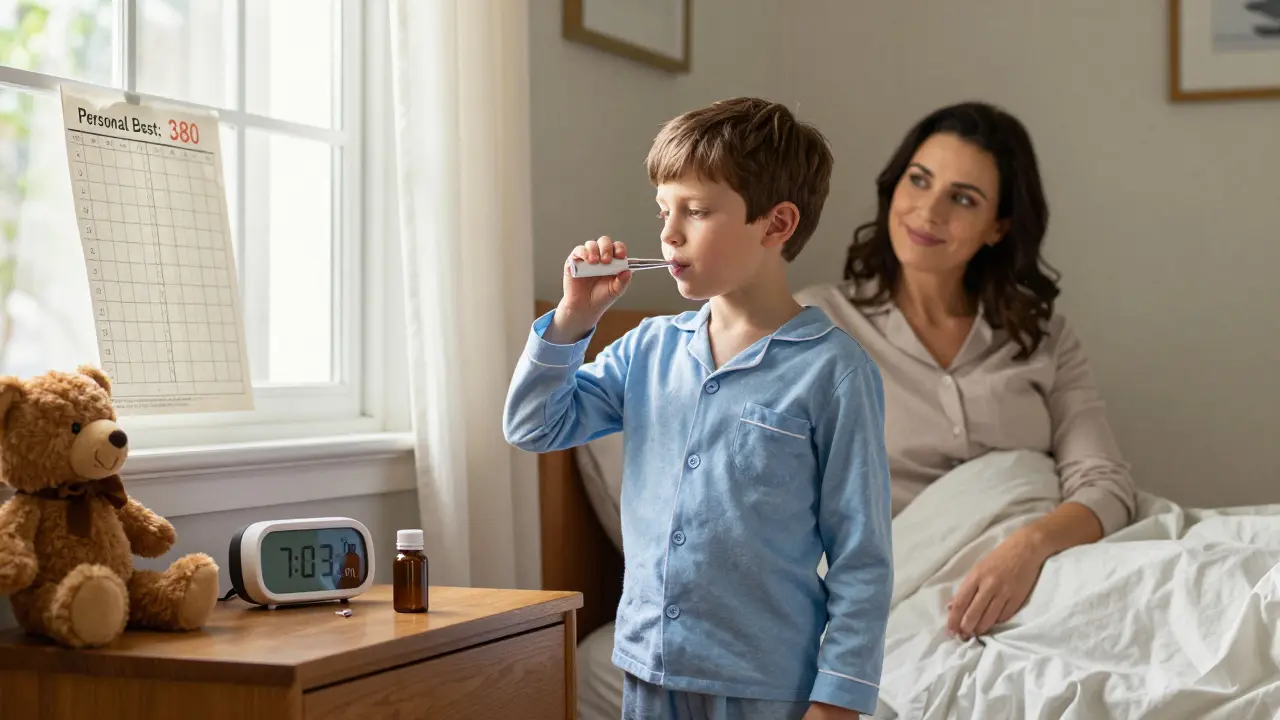

When your asthma feels under control, it’s easy to forget to check in with your lungs. But airflow doesn’t always wait for symptoms to show up. That’s where peak flow monitoring comes in - a simple, daily habit that can give you a heads-up before you start wheezing or coughing. It’s not fancy. It doesn’t need a doctor’s office. All you need is a small handheld device and a few minutes each day. But done right, it can change how you manage your asthma - and maybe even keep you out of the emergency room.
Why Peak Flow Matters More Than You Think
Peak expiratory flow (PEF) measures how fast you can blow air out of your lungs after taking a deep breath. It’s not about how much air you can hold - it’s about how quickly you can push it out. In asthma, your airways narrow, and that speed drops. Often, this drop happens hours or even a full day before you feel any symptoms. For people who don’t notice early warning signs - like chest tightness or slight shortness of breath - peak flow readings are the only early alarm they get.Studies show that regular tracking can catch worsening asthma 24 to 48 hours before symptoms appear. That’s a huge advantage. It means you can act before you’re gasping for air. The 2023 Global Initiative for Asthma (GINA) guidelines still recommend peak flow monitoring for people with moderate to severe asthma, especially when spirometry isn’t available. It’s not the gold standard - spirometry is - but for daily home use, it’s one of the most practical tools you have.
How to Track Your Peak Flow Correctly
Tracking isn’t just about blowing into a meter. It’s about consistency. If you measure at different times of day, with different devices, or without full effort, your numbers won’t mean anything.Here’s how to do it right:
- Use the same peak flow meter every time. Different brands give different readings. Switching meters throws off your entire history.
- Measure at the same times daily. Best practice is once in the morning (between 7 and 9 a.m.) and once in the evening (between 6 and 8 p.m.). Lung function naturally dips in the early morning, so timing matters.
- Stand up straight. Keep your head level. Take a deep breath, seal your lips around the mouthpiece, and blow out as hard and fast as you can - like you’re blowing out birthday candles across the room.
- Do it three times. Record the highest number. Don’t average them. The highest effort is what counts.
- Write it down. Use a notebook, a phone app, or a printed chart. Don’t rely on memory.
Don’t skip days. Even when you feel fine. That’s how you build a pattern. The American Academy of Allergy, Asthma & Immunology recommends tracking twice a day for two full weeks when your asthma is stable. That’s how you find your personal best.
Finding Your Personal Best
Your personal best isn’t what the chart on the meter says. It’s not what your doctor guesses based on your age or height. It’s the highest number you can consistently blow out when your asthma is under control.Here’s how to find it:
- Track twice daily for two to three weeks while feeling well - no symptoms, no rescue inhaler use.
- Record every reading, even if you think it’s low.
- After three weeks, pick the highest number you got. That’s your personal best.
This number becomes your baseline. Everything else is measured against it. For kids, this number changes as they grow. Recheck it every six to twelve months. If your asthma gets worse or you start a new medication, re-establish your personal best.
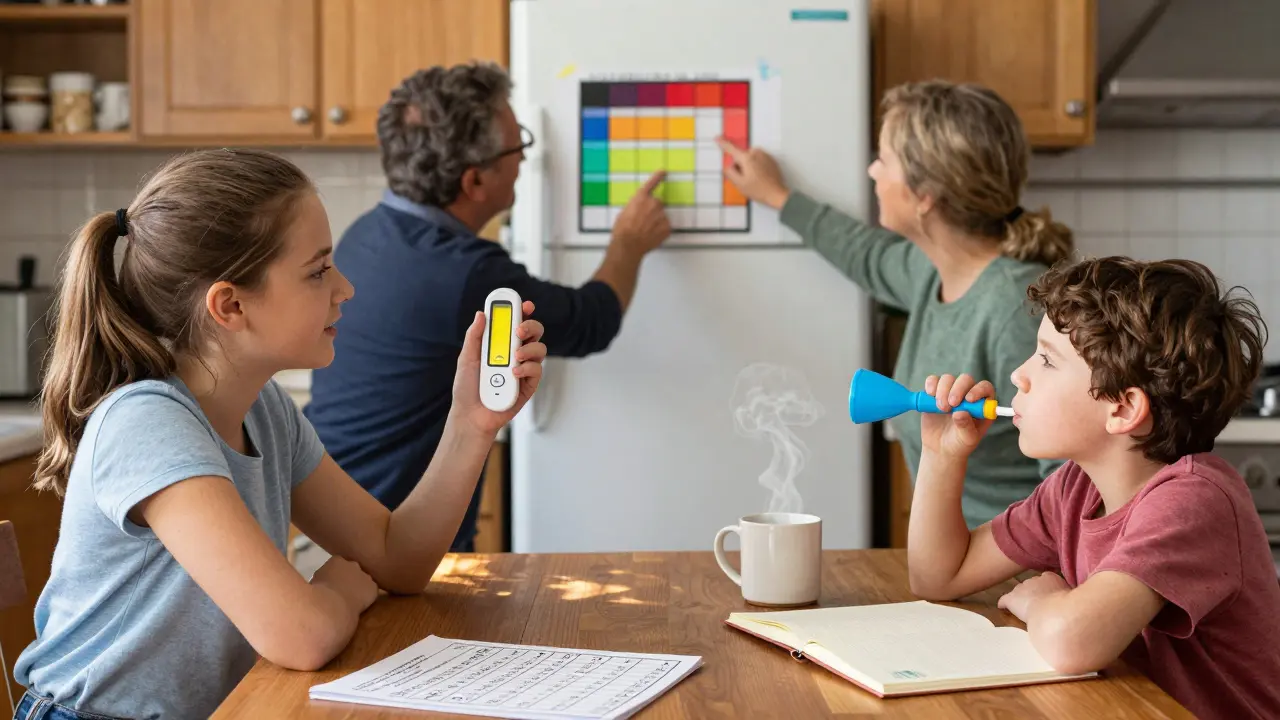
The Traffic Light System: Green, Yellow, Red Zones
Once you know your personal best, you divide it into three zones - like a traffic light.- Green Zone (80% or higher): You’re doing well. No changes needed. Keep taking your meds as prescribed.
- Yellow Zone (50% to 79%): Caution. Your airways are narrowing. You may not feel symptoms yet, but your body is sending a signal. Follow your asthma action plan. Increase your controller medication if your doctor told you to. Check your peak flow more often - maybe every 4 to 6 hours.
- Red Zone (below 50%): Medical alert. Your airways are severely restricted. This is dangerous. Take your rescue inhaler immediately. Call your doctor or go to the ER. Don’t wait. Studies show that people who follow their action plan based on peak flow zones have fewer hospital visits and better quality of life.
The American Lung Association and the Asthma and Allergy Foundation of America both use this system. It’s simple, visual, and backed by decades of clinical use. A drop of 20% to 30% from your personal best can mean an asthma episode is starting - even if you feel fine.
Who Needs This Most?
Not everyone with asthma needs daily peak flow tracking. But some people benefit more than others.- If you have moderate or severe asthma - do it twice daily.
- If you’ve had a serious flare-up in the past year - this is critical.
- If you don’t notice symptoms until you’re struggling to breathe - this is your early warning system.
- If your asthma changes with seasons, exercise, or stress - tracking helps you spot triggers.
- If you’re a parent managing a child’s asthma - this gives you objective data instead of guessing.
People with mild, stable asthma might only need to check two or three times a week. But if you feel something’s off - check it anyway. Don’t wait for permission.
Common Mistakes and How to Avoid Them
Even with good intentions, people mess up. Here’s what goes wrong - and how to fix it.- Mixing meters: You borrowed your neighbor’s meter. Now your numbers are all over the place. Use one device. Keep it at home. Bring it to every appointment.
- Blowing half-heartedly: You’re tired, or you think it doesn’t matter. But if you don’t give your best effort, you’re not tracking your lungs - you’re tracking your laziness. Blow like your life depends on it. Because sometimes, it does.
- Skipping days: You feel good, so you skip. Then you get a flare-up and wonder why you didn’t see it coming. Consistency builds trust in the data.
- Ignoring morning lows: Your peak flow is naturally lower right after waking. Don’t panic if your morning number is 15% lower than your evening one. That’s normal. But if your morning number is 30% lower than your personal best - that’s a red flag.
- Not updating your personal best: You got sick, gained weight, or started a new steroid. Your lungs changed. Your personal best should change too. Re-test after any big change.

What to Do When Numbers Drop
You check your peak flow. It’s in the yellow. Or worse - red. What now?Follow your written asthma action plan. If you don’t have one, make one with your doctor. Here’s a basic framework:
- Green zone: Keep doing what you’re doing.
- Yellow zone: Use your rescue inhaler. Check again in 15-30 minutes. If it doesn’t improve, call your doctor. Increase controller meds if your plan says to.
- Red zone: Take your rescue inhaler right away. Call your doctor or go to the ER. Do not wait. Do not hope it gets better. This is a medical emergency.
Keep your action plan on your phone, taped to the fridge, or in your wallet. When you’re struggling to breathe, you won’t remember what to do. But you’ll remember where the paper is.
Limitations and What to Watch For
Peak flow meters aren’t perfect. They’re not as accurate as spirometers in a clinic. They can be affected by how hard you blow, your grip on the device, or even how cold the room is. But they’re still the most reliable tool you can use at home.One big warning: never rely on peak flow alone. If you feel terrible but your numbers look fine - trust your body. If you feel fine but your numbers are crashing - trust your meter. Use both.
Also, don’t compare your numbers to someone else’s. Your personal best is yours. A 400 L/min reading for one person might be normal. For another, it’s a crisis. Only your own history matters.
Getting Started Today
You don’t need a prescription. You can buy a peak flow meter at most pharmacies for under $30. Look for a mechanical (wedge-style) or digital model - both work. Make sure it’s not expired. Write your personal best on the device with a marker.Start tomorrow. Set a reminder on your phone: 7 a.m. and 7 p.m. Blow. Record. Repeat. In two weeks, you’ll have a pattern. In three weeks, you’ll know your personal best. And from then on, you’ll know when your asthma is about to flare - before you even feel it.
How often should I check my peak flow if I have mild asthma?
If your asthma is well-controlled and stable, checking two to three times a week is usually enough. But if you notice any changes - like needing your rescue inhaler more often, waking up at night, or feeling tightness - start checking twice daily until you’re back to normal. Don’t wait for symptoms to get worse.
Can I use a peak flow meter if I have COPD?
Peak flow meters are designed for asthma, not COPD. People with COPD often have different breathing patterns, and peak flow readings may not reflect their condition accurately. Spirometry is the preferred tool for COPD. If you have both asthma and COPD, talk to your doctor about which monitoring method works best for you.
Why is my peak flow lower in the morning?
It’s normal. Your airways naturally tighten overnight due to hormonal changes and reduced lung function during sleep. That’s why morning readings are usually lower. What matters is the pattern - if your morning number is consistently 20% lower than your evening number, that’s typical. But if it drops below 50% of your personal best, that’s a red flag.
Do I need to calibrate my peak flow meter?
No, mechanical peak flow meters don’t need calibration. But they can wear out or get blocked with saliva. Clean it weekly with warm water and mild soap. Let it dry completely. If the numbers suddenly seem off - even after cleaning - replace the device. Digital meters may need battery changes or software updates - check the manual.
What if my peak flow is normal but I still feel short of breath?
Trust your body. Peak flow measures large airway flow - not small airway inflammation or other issues like anxiety or heart problems. If you feel breathless, use your rescue inhaler and contact your doctor. Your symptoms matter just as much as your numbers.
Can children use peak flow meters?
Yes - but only if they’re old enough to blow hard and consistently, usually around age 5 or older. Use a child-sized meter if available. Establish their personal best when they’re feeling well, and recheck every six months as they grow. Parents should track daily and follow the same green-yellow-red zones. It’s one of the best ways to prevent school absences and ER visits.



Lori Anne Franklin
26 December 2025just started using my peak flow meter last week and honestly i thought it was pointless til my morning reading dropped 30% and i didnt even feel weird. took my inhaler, slept better, and avoided a full crash. dumb little plastic tube saved my sunday.
Joanne Smith
26 December 2025oh wow. so this is what happens when you stop treating your lungs like a broken toaster you only fix when it smokes. genius. i’ve been blowing into this thing for years and still thought ‘green zone’ was a metaphor for being chill. turns out it’s a medical traffic light. who knew?
also, the fact that you have to blow like you’re trying to win a contest to blow out a candle on a cake across the room? that’s not a medical device, that’s a personality test.
Ellie Stretshberry
27 December 2025i love this so much. i have a 7 year old with asthma and we do this every morning and night. she thinks it’s a game now. she blows hard and yells ‘green zone!’ like she won a prize. i used to panic every time she coughed. now i just check the number. it’s like having a little doctor inside our house.
Ryan Cheng
28 December 2025if you’re reading this and you’ve never tracked your peak flow, just start. don’t wait for an emergency. don’t wait to feel ‘bad enough.’ your lungs don’t care about your schedule. they don’t care if you’re tired or busy. they just send signals. the question is - are you listening?
get a meter. pick a time. blow hard. write it down. do it for two weeks. your future self will thank you. no fluff. no hype. just real life-saving math.
Zina Constantin
29 December 2025as someone who moved from india to the u.s. and had zero access to asthma care for years, this post is a gift. here, we had to guess. here, we waited until we couldn’t breathe. now i have a meter, a chart, and a plan. it’s not magic. it’s just discipline. and discipline is the quietest kind of power.
Jay Ara
31 December 2025my dad used to say ‘if you feel fine dont worry’ and now i know he was wrong. peak flow dont lie. i skipped for a week, felt fine, then ended up in er. now i do it even if i hate it. better than a hospital bill and a 3 hour wait.
Kuldipsinh Rathod
1 January 2026my brother uses this and he’s been stable for 2 years now. before that he was in the hospital every season. its simple. its cheap. its real. why dont more people do this?
SHAKTI BHARDWAJ
1 January 2026peak flow? lol. you people are so obsessed with numbers you forget you’re humans. what if your lungs are fine but your soul is tired? what if you’re just exhausted from life and your body is screaming for rest, not a meter? this feels like medical gaslighting. trust your feelings not plastic tubes.
carissa projo
2 January 2026there’s something deeply poetic about measuring the speed of your breath - a rhythm that’s been with you since birth, now reduced to a number on a plastic stick. we’ve turned survival into data, and yet, somehow, that data gives us back our freedom. maybe that’s the quiet miracle: we don’t need to be afraid anymore because we’ve learned to listen - not to our fear, but to our lungs.
it’s not about control. it’s about harmony. the meter doesn’t tell you what to do. it tells you what’s already happening. and that’s the most honest kind of truth.
josue robert figueroa salazar
3 January 2026peak flow is a scam. if you feel fine you’re fine. stop overthinking. your body knows. the meter doesn’t.
david jackson
4 January 2026okay so imagine this: you’re standing there, mouth wrapped around this little plastic tube, cheeks puffed like a chipmunk on espresso, blowing with the desperation of a man trying to inflate a pool float in a hurricane - and then you look at the number and it’s 310. your personal best is 420. your green zone is 336. you’re in yellow. you didn’t feel a thing. no cough. no wheeze. no panic. just a number. and suddenly you realize - your body has been screaming for days and you were too busy scrolling to notice. this isn’t medicine. this is a mirror. and it’s the most terrifying thing you’ve ever owned.
and then you take your inhaler. and you breathe. and you cry a little. because you’re not broken. you’re just human. and this dumb little device is the only thing that ever taught you that.