

When you're breastfeeding and need to take a short-term medication-whether it's an antibiotic, pain reliever, or something else-it's easy to panic. You might think you have to stop nursing altogether. But here's the truth: fewer than 2% of medications require you to stop breastfeeding. Most can be managed safely with smart storage and labeling. The real challenge isn’t the medicine itself-it’s knowing how to handle your milk so you don’t waste it, and more importantly, so your baby stays safe.
Why Labeling Matters More Than You Think
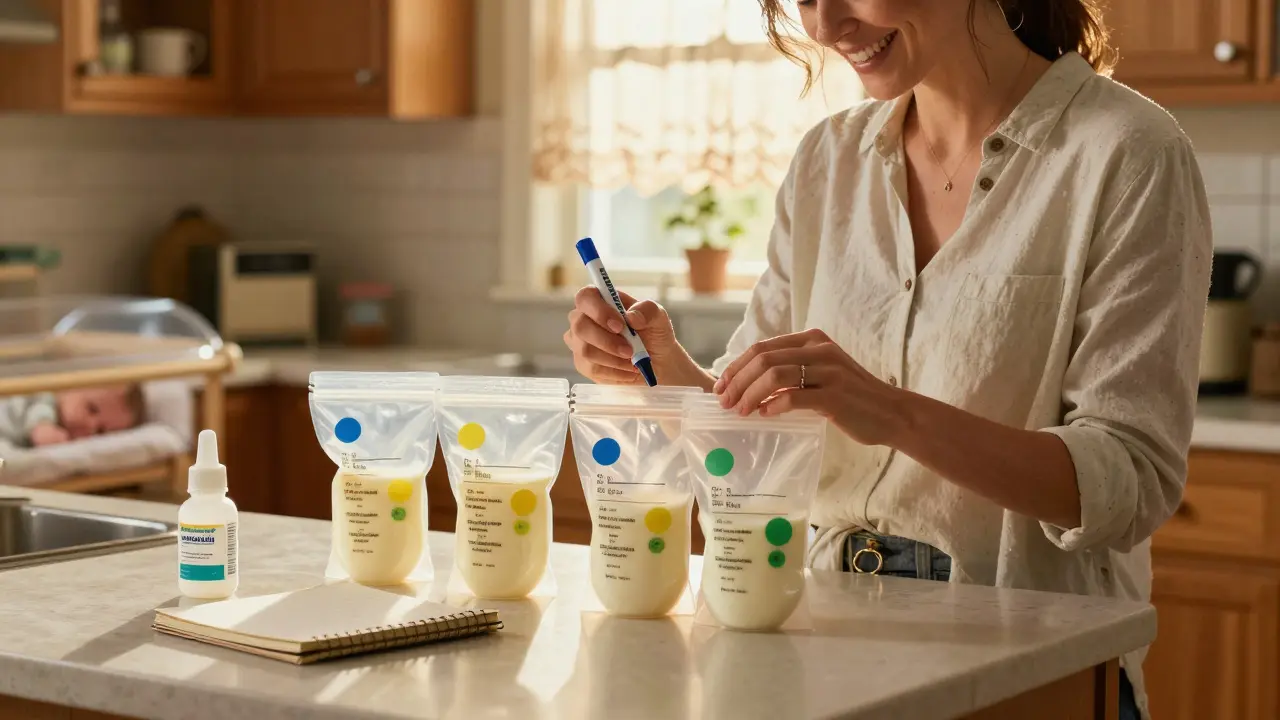
Labeling isn’t just a suggestion. It’s your safety net. When you’re on medication, your milk changes. Not in a scary way, but in a measurable one. Some drugs pass into breast milk in tiny amounts, peak at certain times after you take the dose, and then fade out. If you mix milk from before, during, and after your medication, you’re unknowingly giving your baby inconsistent doses. That’s why every container must have:- The date and time you pumped
- Your baby’s name
- The name of the medication
- The dose you took
- The time you took it
Storage Rules That Still Apply (But With a Twist)
The standard storage guidelines still work, but now you have to separate your milk into batches based on timing. Here’s what you need to know:- Room temperature (up to 4 hours): Only use milk pumped within 4 hours of taking your medication if your doctor says it’s safe. Otherwise, store it separately.
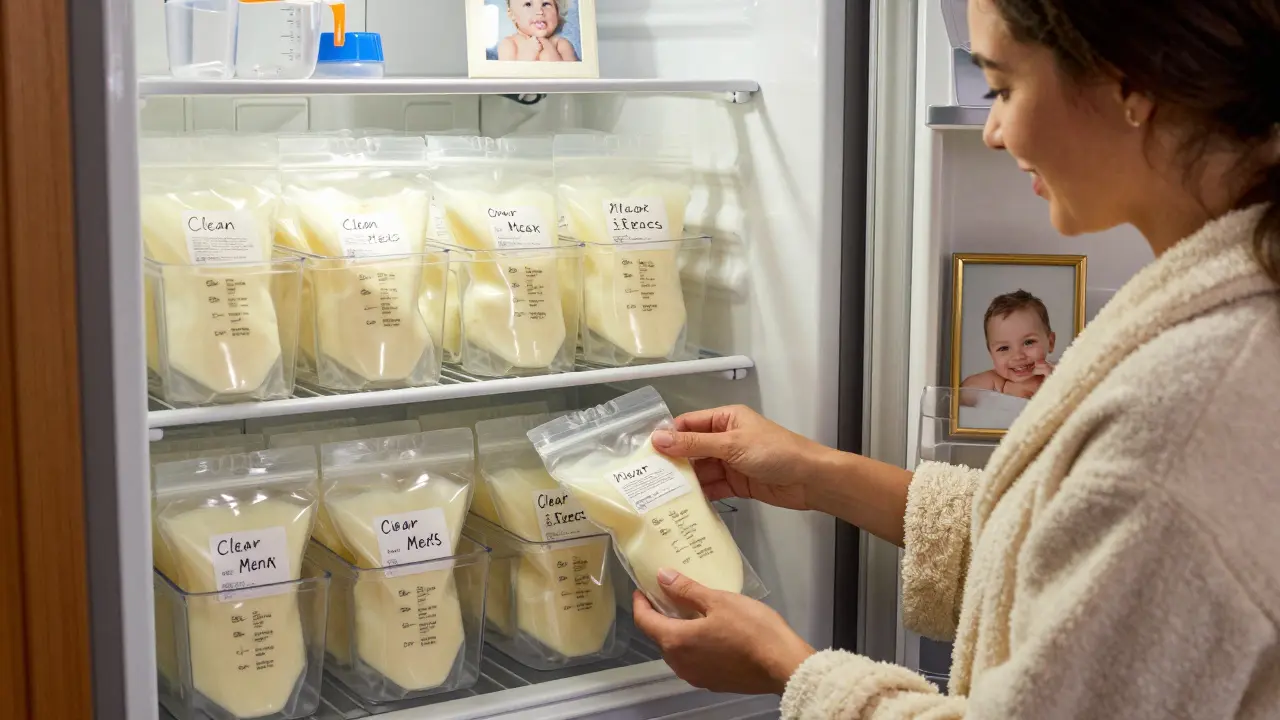
- Refrigerator (up to 4 days): This is your safest option for short-term storage. Keep pre-medication milk and post-medication milk in different containers. Label them clearly.
- Freezer (6-12 months): Use this for long-term storage. Freeze milk in 2-4 ounce portions so you can thaw only what you need. Never refill a container once it’s been thawed.
When to Pump and Dump (And When Not To)
You’ve probably heard the phrase "pump and dump." It sounds dramatic, and most of the time, you don’t need to do it. In fact, the Academy of Breastfeeding Medicine says most medications don’t require you to discard milk at all. Here’s how to decide:- Don’t pump and dump: If you’re taking a common medication like ibuprofen, acetaminophen, amoxicillin, or most antidepressants. These transfer minimally into milk, and their half-lives are short. Just time your feeds.
- Consider pump and dump: Only if your doctor says so-for rare medications like certain chemotherapy drugs, radioactive compounds, or strong sedatives. Even then, it’s often only needed for 24-48 hours.
How to Separate and Store Milk Like a Pro
You’re not just storing milk-you’re managing a timeline. Here’s how to do it without confusion:- Use color-coded labels. Blue = pre-medication, yellow = during peak concentration, green = after medication clears. This visual system helps you avoid mixing batches.
- Use dedicated storage bags. Breast milk bags with built-in writing areas are better than jars. They’re less likely to leak and easier to label.
- Keep a log. Write down each time you pump, what you took, and when. Even a simple notebook works. Apps like MotherToBaby can auto-generate labels based on your medication.
- Store in the back of the fridge. That’s the coldest spot. Front shelves warm up every time you open the door.
- Don’t fill containers to the top. Milk expands when frozen. Leave at least an inch of space. Otherwise, you’ll have a messy freezer disaster.
What to Do When You’re Out and About
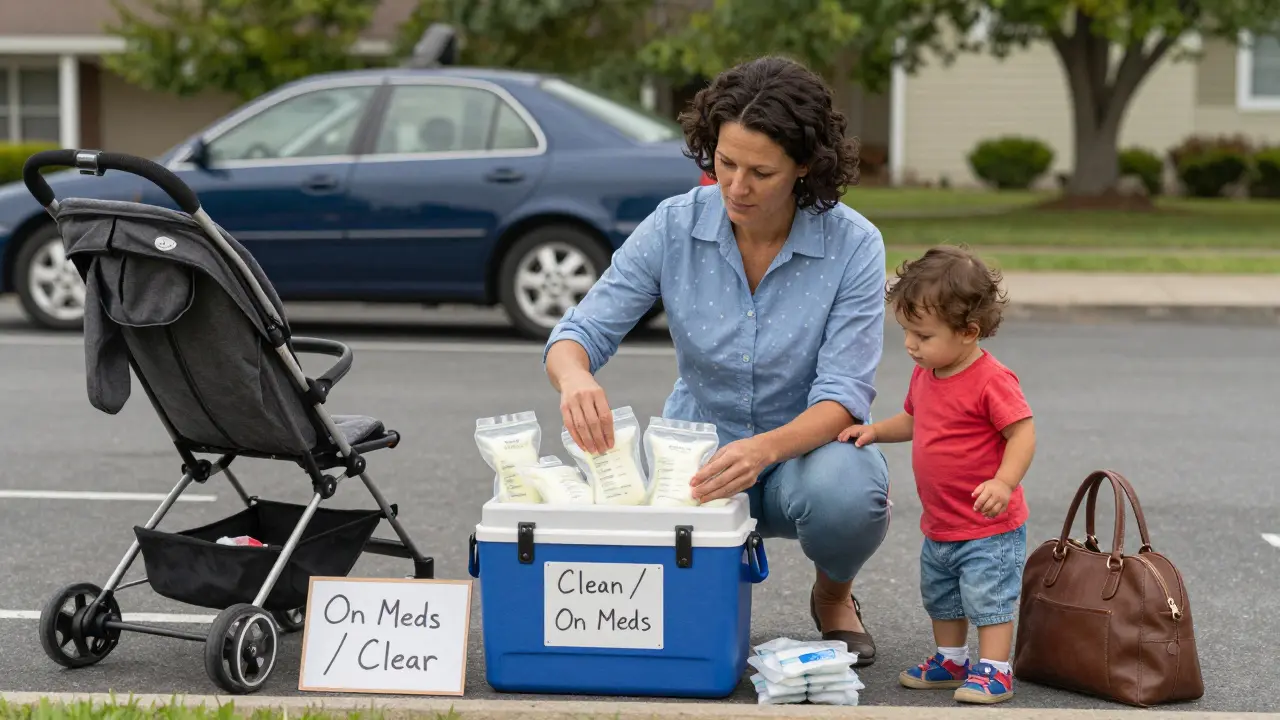
Traveling, working, or running errands while on meds? You need a portable system.- Carry a small insulated cooler with frozen ice packs. You can keep milk cold for up to 24 hours this way.
- Use pre-labeled, pre-filled storage bags. Write the info before you leave home.
- If you pump at work or on the go, store the milk immediately in the cooler. Don’t leave it in a car or on a counter.
- When you get home, transfer it to the fridge or freezer right away. No delays.
What Happens If You Mix the Milk?
Mixing milk from different times is the most common mistake. You might think, "It’s all breast milk, it’ll be fine." But that’s not true. If you combine milk from before and after taking a medication, you’re creating a mixture with unpredictable drug levels. Your baby might get too much-or too little. Either way, it’s unnecessary risk. One mom in Sydney shared her story: She took a 5-day course of amoxicillin and mixed all her milk. Her baby had a mild rash for 48 hours. After she started separating batches and labeling them, the rash disappeared. She didn’t stop nursing. She just started labeling.What If You’re Not Sure About Your Medication?
You don’t have to guess. There are trusted resources:- LactMed (NIH database): Free, evidence-based info on hundreds of medications and breastfeeding.
- MotherToBaby: Call or chat with specialists who give real-time advice.
- Your IBCLC (International Board Certified Lactation Consultant): They’re trained for this exact scenario.
What About Thawed Milk?
Once you thaw milk, you have 24 hours to use it if it’s been refrigerated. But if it was frozen milk collected during a medication window, you need to be extra careful. If you thawed milk that was pumped during peak medication time, and you’re not sure whether it’s safe to use, don’t risk it. Discard it. But if it was pumped before you started the medication, or after the drug cleared your system, it’s perfectly safe.How to Know When It’s Safe to Use Stored Milk
Most medications clear your system within 12-48 hours. For short-term prescriptions (like a 5-day antibiotic), you can usually resume using your stored milk after 48 hours from your last dose. But here’s a shortcut: Check the half-life. If the drug’s half-life is under 4 hours, it’s likely safe after 24 hours. If it’s over 8 hours, wait 48-72 hours. Your pharmacist or doctor can tell you this. And if you’re still unsure? Test it. Pump a small amount after your last dose, wait 2 hours, and give it to your baby. Watch for any reaction. If nothing happens, the rest of your milk is probably fine.What You Shouldn’t Do
- Don’t throw away milk just because you’re on meds. Most of it is safe.
- Don’t use handwritten labels that smudge. Use waterproof ink or printed labels.
- Don’t rely on memory. Write it down every time.
- Don’t assume all doctors know the rules. Many don’t. Be your own advocate.
Real-Life Tip: The 3-Label System
One mother in Melbourne started using three labels:- "Clean" - pumped before meds
- "On Meds" - pumped during peak time
- "Clear" - pumped 48 hours after last dose
Storing and labeling milk while on medication isn’t about fear. It’s about control. You’re not giving up breastfeeding. You’re just being smart about it.
Do I need to pump and dump if I take a one-time painkiller like ibuprofen?
No. Ibuprofen transfers into breast milk in very small amounts and clears quickly. You can keep breastfeeding as normal. Just avoid taking it right before a feeding-wait at least 2 hours after taking it to nurse.
Can I freeze milk that was pumped while I was on antibiotics?
Yes, if you waited at least 48 hours after your last dose. Most antibiotics like amoxicillin or cephalexin are safe in breast milk. But label it clearly with the medication name and date of last dose. Don’t mix it with milk from before you started the meds.
How long should I wait after taking a medication before I can feed my baby?
It depends on the drug. For most common medications, waiting 2-4 hours after taking it is enough. Take the pill right after a feeding, so the peak concentration happens while your baby is sleeping. Always check with your doctor or a lactation consultant for specifics.
Is it safe to use milk stored before I started the medication?
Absolutely. Milk you pumped before starting the medication is completely safe to use, even while you’re still on the drug. Just make sure it’s clearly labeled and kept separate from milk collected during treatment.
What if I accidentally mixed milk from before and after my medication?
If you mixed it once, don’t panic. Most medications don’t cause harm in small amounts. But don’t do it again. Going forward, keep separate batches and label them. If your baby shows signs of unusual fussiness, rash, or diarrhea, stop using the mixed milk and consult your pediatrician.
Managing breast milk while on temporary medication is not about perfection. It’s about awareness. You’ve done this before-feeding, pumping, storing. Now you’re just adding one more layer: information. With clear labels, smart timing, and trusted resources, you can keep breastfeeding safely. You’ve got this.





Marissa Staples
22 March 2026Labeling milk like this feels like a small act of rebellion against the chaos of new motherhood. It’s not just about safety-it’s about reclaiming control when everything else feels out of your hands. I didn’t realize how much peace of mind a simple label could give until I started doing it. No more guessing. No more panic. Just clear, quiet confidence.
And honestly? The color-coding changed everything. Blue, yellow, green-I started treating it like a ritual. It made me feel like I was doing something intentional, not just reactive.
I used to think I was overcomplicating it. Now I think I was underestimating how much my baby deserved that kind of care.
Korn Deno
22 March 2026Most people don't realize the real enemy here isn't the medication it's the assumption that you have to choose between health and breastfeeding. You don't. You just need to be systematic. The 4s rule is solid but the labeling is what turns theory into practice. No fluff just facts and a little discipline.
Pat Fur
23 March 2026I used to mix everything. Then my little one got a weird rash. Turned out it was the amoxicillin milk I didn't label. Now I have a whole system. Blue bag = before. Yellow = during. Green = clear. It's like a color code for love. And yes I cry every time I label a bag. It's that meaningful.
Anil Arekar
24 March 2026The systematic approach outlined here reflects a profound understanding of maternal care as both scientific and deeply human. Adherence to precise labeling protocols not only mitigates potential pharmacological risk but also affirms the dignity of the nursing relationship. This is not mere logistics-it is an ethical practice grounded in evidence and compassion.
Natasha Rodríguez Lara
26 March 2026I love how this post doesn't just say 'do this' but explains why. I'm one of those moms who thought pump and dump was the only option. Turns out I was scared of the wrong thing. The real issue was not knowing how to organize. Now I use MotherToBaby app and it auto-generates labels. Game changer.
Caroline Bonner
26 March 2026Okay I need to say this out loud because I think so many of us are silently struggling with this and no one talks about it: the emotional labor of labeling milk is real. It's not just about remembering to write down the time and dose-it's about sitting there with a bottle in your hand, thinking about how your body is still working for your baby even when you're on meds, even when you feel broken or tired or overwhelmed.
I started using those little sticky notes with glitter pen because I needed something that felt a little joyful in the middle of all the clinical stuff. My freezer looks like a rainbow now. And every time I pull out a bag, I whisper 'I got you, baby.'
Also I have a whole binder now. With tabs. And a flowchart. And a checklist. And a backup checklist. I'm obsessed. But I'm not sorry.
Also I once accidentally froze a bag labeled 'Amoxicillin' next to a bag labeled 'I love you'-and I cried for 20 minutes. It was a weird moment. But it was real.
Linda Foster
28 March 2026The CDC and Academy of Breastfeeding Medicine guidelines are clear. Misinformation persists because of fear, not science. Proper labeling is not optional-it is a standard of care. I encourage all healthcare providers to distribute this information at prenatal visits.
Rama Rish
30 March 2026use color code its so easy. blue before, yellow during, green after. i did it for my 2nd and it saved my supply. no more waste. no more stress. just label and go.
rebecca klady
31 March 2026I accidentally mixed milk once. My baby was fine. But I won’t do it again.