
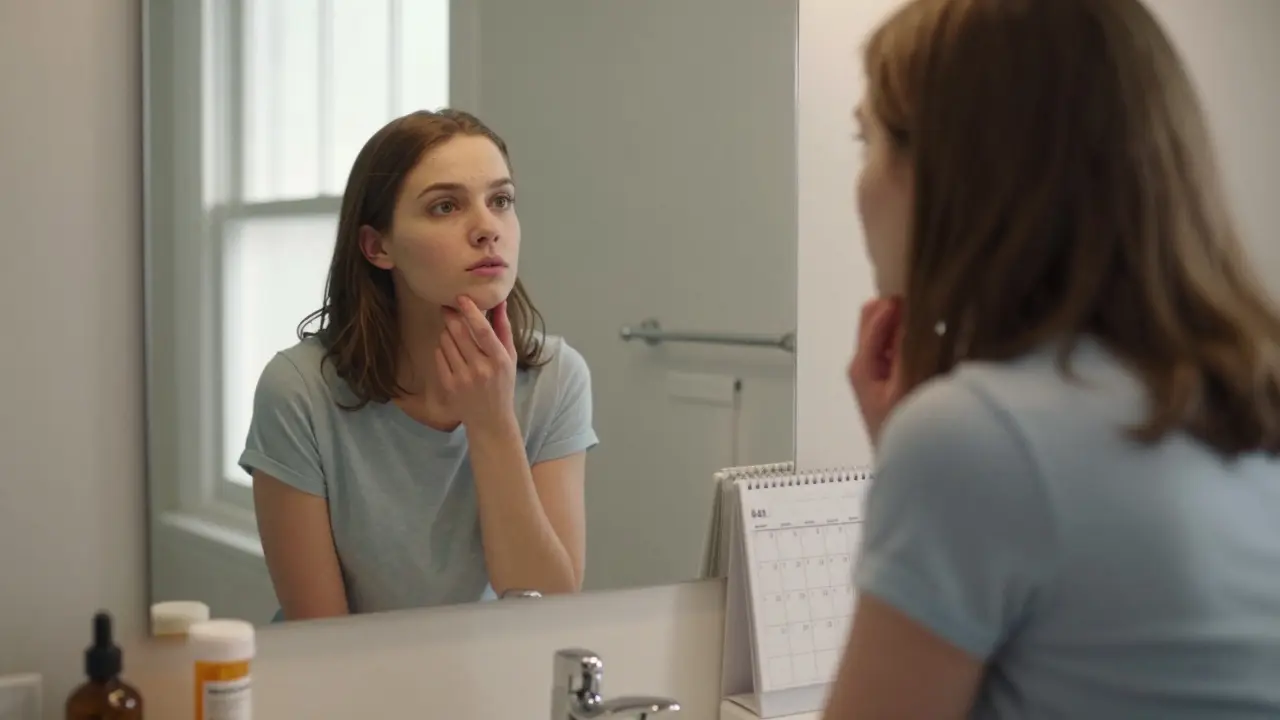

When you have PCOS, unwanted facial or body hair isn’t just a cosmetic concern-it’s a daily reminder of a hormonal imbalance you didn’t ask for. About 70-80% of women with PCOS deal with hirsutism: thick, dark hair growing where it shouldn’t-on the chin, upper lip, chest, or back. It’s not just about appearance. It affects confidence, mental health, and quality of life. Many try shaving, waxing, or threading for years before realizing they need something that targets the root cause: excess androgens.
Why Antiandrogens Are Used for PCOS Hirsutism
Hirsutism in PCOS happens because the body makes too many male hormones-testosterone and DHT. These hormones turn fine, light vellus hair into thick, dark terminal hair. Antiandrogens don’t remove hair directly. They block the hormones that make it grow. Think of them as interrupting the signal that tells hair follicles to go into overdrive. The two most common antiandrogens used today are spironolactone and finasteride. Spironolactone works in two ways: it blocks androgen receptors in the skin and reduces the enzyme that turns testosterone into the stronger DHT. Finasteride is more targeted-it only blocks that one enzyme (5-alpha-reductase type II), cutting DHT production by up to 70%. Both are taken daily as pills. There’s also eflornithine cream, a topical treatment that slows hair growth at the follicle level without affecting hormones systemically.What the Evidence Really Says
It’s easy to find online claims that antiandrogens are miracle cures. But the science is more nuanced. According to the 2023 International Evidence-based Guideline for PCOS, antiandrogens are not first-line treatment. That spot belongs to combined oral contraceptive pills (COCPs), which lower androgens and regulate cycles. About 75% of women with PCOS start with COCPs. Antiandrogens come in when COCPs don’t work well enough-or can’t be used. Maybe you have high blood pressure, migraines with aura, or you’re trying to get pregnant. Or maybe you’ve been on a COCP for six months with little change in hair growth. That’s when doctors consider adding spironolactone or finasteride. A 2023 meta-analysis from Monash University found that adding an antiandrogen to a COCP led to significantly better hair reduction than COCPs alone. The modified Ferriman-Gallwey (mFG) score-a clinical tool that measures hair growth in nine body areas-dropped by an average of 1.7 points more with combination therapy. That might sound small, but for someone with an mFG score of 18, dropping to 11 means visible, meaningful change.How Long Does It Take to See Results?
This is where most people get discouraged. Hair growth cycles are slow. You won’t see results after a week or even a month. It takes 6 to 9 months to notice any difference. Maximum improvement often takes 18 to 24 months. That’s why consistency matters more than intensity. Taking spironolactone every other day? Studies show daily use cuts androgen levels more effectively and leads to better hair reduction. One Reddit user, PCOSWarrior2020, shared: “After 8 months on Yaz with no change, I added 100mg spironolactone. At 6 months on the combo, my mFG score dropped from 18 to 11. It’s noticeable-but not perfect.” That’s typical. You’re not failing. You’re just early in the process.Side Effects and Safety Risks
No medication is without trade-offs. Spironolactone can cause dizziness, fatigue, or increased urination. It can also make periods irregular or heavier. About 30-40% of users report side effects, especially when starting at high doses. That’s why doctors usually begin with 25-50mg daily and slowly increase to 100-200mg over months. Finasteride has fewer physical side effects but carries a black box warning from the FDA for rare, persistent sexual side effects like low libido or erectile dysfunction-even after stopping the drug. It’s not common, but it’s real. The biggest risk? Birth defects. Both spironolactone and finasteride can harm a developing male fetus. That’s why you must use two forms of birth control while taking them. One pill isn’t enough. You need a barrier method (like condoms) plus hormonal contraception. The 2023 PCOS guideline is clear: no antiandrogen without reliable contraception.
Topical Option: Eflornithine Cream
If pills aren’t an option, eflornithine cream (brand name Vaniqa) offers a non-systemic alternative. Applied twice daily to affected areas, it slows hair growth by blocking an enzyme needed for hair production. It doesn’t remove hair-it makes it finer and slower-growing. Studies show about 60% of users see improvement after six months. It’s not a magic solution. Hair grows back if you stop using it. But it’s safe to use during pregnancy (unlike oral antiandrogens) and can be combined with laser therapy. One clinical pearl found that adding eflornithine to laser treatment improved hair reduction by 35% compared to laser alone. The downside? Cost. A 30-tube pack of Vaniqa runs about $245 in the U.S. without insurance. Generic alternatives aren’t available yet. For many, this makes it a short-term or supplemental option.What Doesn’t Work as Well
Some treatments get overhyped. Metformin helps with insulin resistance and weight, but it doesn’t significantly reduce hirsutism on its own. A 2023 meta-analysis found no meaningful difference in hair growth between metformin + lifestyle and antiandrogen + lifestyle. So if your main goal is hair reduction, metformin alone won’t cut it. Flutamide used to be used, but it’s been pulled from use due to liver damage risks. Cyproterone acetate is banned in many countries because of meningioma risk. Bicalutamide is sometimes used off-label but lacks long-term safety data in women.Combination Therapy: The Real Game-Changer
The most effective approach isn’t one drug-it’s a layered strategy. Many clinicians now use:- Combined oral contraceptive pill (to lower androgens and regulate cycles)
- Spironolactone or finasteride (to block remaining androgen effects)
- Eflornithine cream (to slow growth in targeted areas)
- Laser or IPL hair removal (to permanently reduce follicles)

Cost, Access, and Real-World Challenges
Spironolactone is cheap-about $46 for a 60-day supply of generic 100mg tablets in the U.S. Finasteride is more expensive, especially if you’re paying cash ($85/month). Insurance often covers it, but prior authorizations can delay treatment for weeks. Eflornithine is rarely covered by insurance for PCOS-related hirsutism, even though it’s FDA-approved. Many patients pay out-of-pocket or use discount programs. Access to specialists matters too. Dermatologists manage 45% of hirsutism cases. Endocrinologists handle 30%. But many OB/GYNs still don’t know the latest guidelines. If your doctor says “just wax it,” ask if they’ve read the 2023 International PCOS Guideline. You deserve better.What to Expect in the Future
New drugs are on the horizon. Selective androgen receptor modulators (SARMs) like enobosarm (GTx-024) are in Phase II trials. Early results show 28% greater hair reduction than placebo after 24 weeks-with fewer side effects than current antiandrogens. Results are expected in mid-2024. Researchers are also exploring genetic markers that predict who responds best to which treatment. One day, a simple blood test might tell you whether spironolactone or finasteride is more likely to work for you. For now, the best approach is patience, persistence, and a smart team. Don’t give up after three months. Don’t skip doses because you’re frustrated. And don’t assume you’re the only one struggling. On Reddit’s r/PCOS, over 125,000 women share the same journey-slow, frustrating, but often worth it.Final Takeaways
- Hirsutism in PCOS is caused by excess androgens-not poor hygiene or diet.
- Antiandrogens (spironolactone, finasteride) are second-line treatments, used when COCPs fail or aren’t safe.
- Results take 6-24 months. Consistency beats intensity.
- Always use two forms of birth control while on antiandrogens.
- Eflornithine cream is a safe, non-systemic option that works well with laser therapy.
- Combination therapy (pill + antiandrogen + cream + laser) gives the best long-term results.
- Cost and access are real barriers. Advocate for yourself and ask for guidance from endocrinology or dermatology specialists.
Unwanted hair doesn’t define you. But managing it well can give you back control. The path isn’t quick, but it’s proven.
Can antiandrogens completely remove hair in PCOS?
No. Antiandrogens reduce hair growth by blocking the hormones that trigger it. They don’t remove existing hair or destroy follicles. For actual hair removal, you need laser or electrolysis. Antiandrogens make hair finer, lighter, and slower-growing-so fewer treatments are needed over time.
Is spironolactone safe for long-term use in PCOS?
Yes, when monitored. Long-term studies show spironolactone is generally safe for years when used under medical supervision. The main risks are high potassium levels (especially in people with kidney issues) and menstrual irregularities. Blood tests every 6-12 months are recommended to check kidney function and electrolytes.
Can I take finasteride if I’m trying to get pregnant?
No. Finasteride is FDA category X, meaning it’s known to cause birth defects. You must stop it at least 1 month before trying to conceive. Spironolactone also carries risks and should be stopped before pregnancy. Neither should be used during pregnancy. Always use two forms of contraception while taking either drug.
Why do some women say antiandrogens made their hair worse?
It’s rare, but possible. Some women report temporary shedding or increased hair growth in the first 2-4 months. This is often a sign the follicles are adjusting-not worsening. If hair growth increases after 6 months, it may mean the dose is too low, or another hormone issue (like thyroid dysfunction) is present. Talk to your doctor before stopping.
Do I need to take antiandrogens forever?
Not necessarily. Many women stop after 1-2 years once hair growth slows significantly. Some keep taking them long-term because PCOS is chronic. Others switch to laser as their primary method. There’s no rule-you and your doctor can reassess every 6-12 months based on your progress and goals.




Liz MENDOZA
28 December 2025Just wanted to say thank you for writing this. I’ve been on spironolactone for 14 months and honestly, I almost quit at month 8. But then I saw my chin hair get lighter-like, actually lighter-and I kept going. It’s not gone, but I don’t flinch when I look in the mirror anymore. You’re not alone.
Caitlin Foster
29 December 2025So… you’re telling me I need to wait TWO YEARS to see results? And I can’t even take a nap without peeing 3x? And I have to use TWO forms of birth control?? I didn’t sign up for this. I signed up for a wax and a margarita.
Will Neitzer
30 December 2025It is imperative to underscore the clinical rigor underpinning the management of hirsutism in polycystic ovary syndrome. The evidence-based hierarchy, as delineated in the 2023 International Guideline, unequivocally positions combined oral contraceptives as first-line therapy. The adjunctive use of antiandrogens must be predicated upon documented therapeutic insufficiency or contraindication to hormonal contraception. Furthermore, the imperative for dual contraception cannot be overstated, given the teratogenic potential of both spironolactone and finasteride.
Janice Holmes
30 December 2025Okay but have you seen the side effect profile of spironolactone?? It’s like your body turns into a glitchy robot-dizziness, fatigue, your period becomes a horror movie, and then you start craving pickles at 3 a.m. AND you’re on birth control? What even is life?? I swear, Big Pharma is just selling us a dream and charging $46 for the illusion.
Olivia Goolsby
31 December 2025Let me guess-this is all a cover-up. The FDA, Big Pharma, and the endocrine establishment are pushing these drugs because they don’t want you to know that hirsutism is caused by glyphosate in your water and the government’s secret fluoride agenda. Spironolactone? It’s just a distraction. Real solutions? Detox your liver, drink apple cider vinegar, and stop watching TikTok. Also, why is finasteride even legal? It’s literally a chemical weapon disguised as a pill. And they want you to take it for YEARS?? Wake up, sheeple.
Monika Naumann
31 December 2025In India, we have been treating hormonal imbalances through Ayurveda for over 5,000 years. You people rely on chemicals from laboratories, while our ancient wisdom uses neem, turmeric, and ashwagandha. Why are you so blind to traditional knowledge? This modern medicine is a Western scam. Your body is not a machine to be fixed with pills.
Raushan Richardson
1 January 2026Just started spiro last month and I’m already feeling like a zombie, but I’m holding on. I saw your post about the mFG score dropping and it made me cry a little. I thought I was the only one stuck in this slow grind. Keep going. You’re doing great.
Robyn Hays
1 January 2026What if we stopped seeing hirsutism as a problem to be fixed and started seeing it as a signal? Like, your body’s trying to tell you something about insulin resistance, stress, or inflammation. Maybe the real fix isn’t blocking androgens-it’s healing the system from the inside out. I’ve been doing low-glycemic eating, yoga, and sleep hygiene for a year now. My hair’s not gone, but I feel… calmer. Maybe that’s the real win.
Liz Tanner
2 January 2026Thank you for mentioning eflornithine. I’ve been using Vaniqa for 8 months with laser. It’s expensive, yes-but I’ve cut my laser sessions in half. And no systemic side effects. If you’re not ready for pills, this is your quiet hero. Just apply it like you’re tucking your skin in at night. Slow, but steady.
Babe Addict
2 January 2026Everyone’s acting like spironolactone is some miracle drug. Bro, it’s just a potassium-sparing diuretic repurposed for hair. It was originally for hypertension. And finasteride? That’s a prostate pill for men. Women are just guinea pigs for off-label use. The science is thin. The side effects are real. And no one’s talking about how many women just stop taking it because they feel like garbage.
Satyakki Bhattacharjee
3 January 2026Why do women care so much about hair? In my village, we have many women with thick hair on face. They do not cry. They work. They raise children. They do not need pills. You think too much. Nature is enough.
Kishor Raibole
4 January 2026It is regrettable that modern medical discourse has devolved into a cacophony of anecdotal testimonies and commercialized pharmaceutical narratives. The pathophysiology of hirsutism in PCOS is a complex interplay of endocrine, genetic, and environmental factors-yet the prevailing paradigm reduces it to a pharmacological algorithm. One must ask: Is the pursuit of aesthetic conformity the ultimate goal of medicine? Or should we be cultivating resilience, acceptance, and holistic well-being beyond the mirror?