

GI Medication Absorption Checker
Check Your Medication Absorption Risk
Enter your medication and habits to see how they might affect absorption.
Absorption Assessment
Many people take pills every day without thinking about what happens after they swallow them. But for gastrointestinal medications, what happens inside your gut can make the difference between a drug working perfectly or not working at all. The truth is, oral medications don’t just disappear into your bloodstream. They face a series of barriers - some natural, some caused by disease - that can block, delay, or destroy them before they ever reach their target.
Why Your Stomach and Intestines Fight Your Medication
Your digestive system isn’t designed to let drugs pass through easily. It’s built to break down food, not deliver medicine. The stomach’s acid can destroy drugs before they even leave the upper GI tract. The small intestine, where most absorption happens, has a thick mucus layer that slows down drug movement. Then there are efflux pumps - tiny molecular gates on intestinal cells - that actively push certain drugs back out into the gut instead of letting them into your blood. These are called P-glycoprotein transporters, and they’re especially stubborn with antibiotics, heart medications, and even some cancer drugs.Even if a drug survives the journey, it doesn’t mean it’s in your system. The liver gets first dibs. After a pill is absorbed, blood from the intestines flows straight to the liver before reaching the rest of the body. This is called first-pass metabolism. For some drugs, up to 90% of the dose gets broken down by liver enzymes before it ever circulates. That’s why some medications need to be given in much higher doses orally than they would if injected.
Food, pH, and Timing: The Hidden Rules
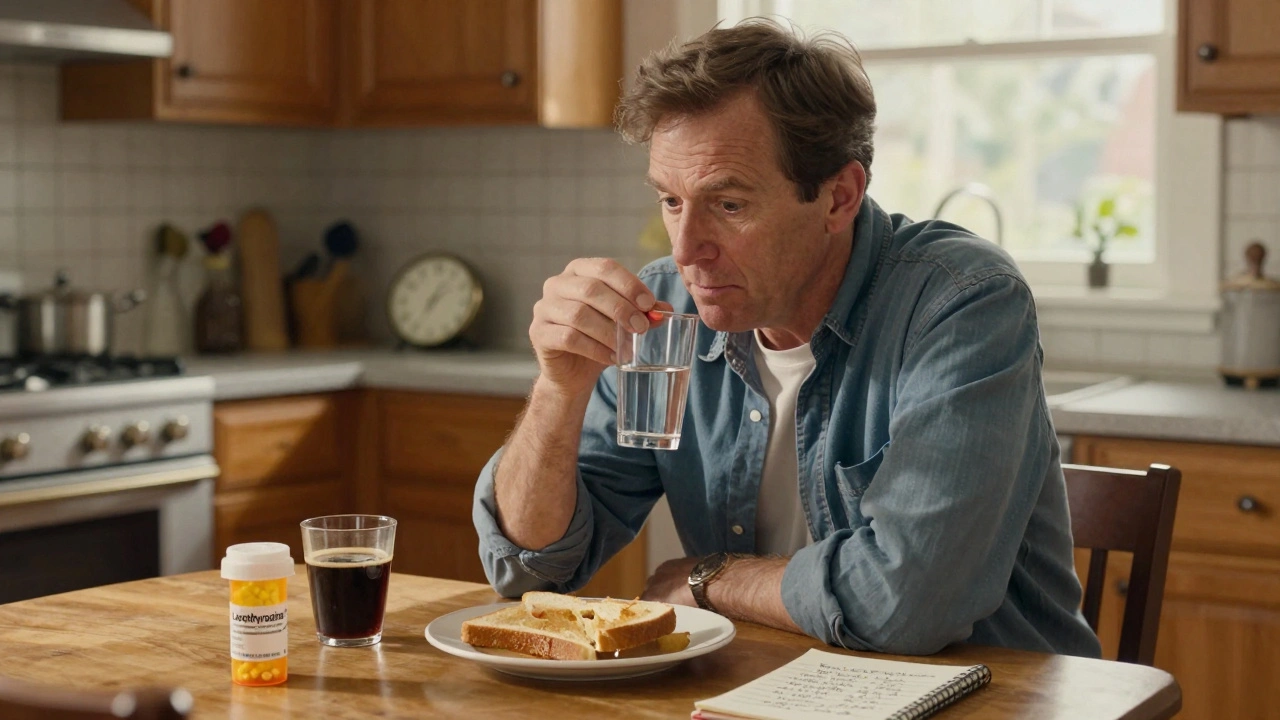
You’ve probably heard to take some pills on an empty stomach. There’s a reason. Food - especially fatty meals - can slow down how fast your stomach empties. That delay can cut peak blood levels of certain drugs by 30 to 50%. Levothyroxine, used for thyroid problems, is a classic example. If you take it with coffee, calcium supplements, or breakfast, your body absorbs far less. That means your thyroid levels stay low, even if you’re taking the right dose.The pH of your gut changes as you move down. The stomach is highly acidic (pH 1.5-3.5), while the upper small intestine is mildly acidic (pH 4-5), and the lower part becomes almost alkaline (pH up to 8). Drugs that dissolve best in acid - like some antibiotics - won’t absorb well if your stomach pH is raised by antacids or proton pump inhibitors. On the flip side, drugs that need an alkaline environment to dissolve, like some antifungals, may not break down properly if you have low stomach acid from long-term acid suppressant use.
Formulation Matters More Than You Think
Not all pills are created equal. A drug’s physical form - whether it’s a tablet, capsule, suspension, or extended-release version - affects how quickly it dissolves. Dissolution is often the limiting step. If a drug doesn’t dissolve fast enough, your body won’t absorb it, no matter how well-designed the molecule is. That’s why manufacturers make different versions: salt forms, nanoparticles, or lipid-based carriers. For example, some newer formulations of antifungal drugs use solid lipid nanoparticles to boost absorption by up to 3.5 times in preclinical studies.Some drugs are designed to release slowly. But if your gut moves too fast - like in diarrhea-predominant IBS - those extended-release pills may pass through before releasing their full dose. Conversely, if your gut moves too slowly - as in constipation or diabetes-related gastroparesis - the drug may sit too long and degrade. That’s why patients with short bowel syndrome often need two or three times the normal dose of many medications. Their surface area for absorption is cut in half, so the body struggles to get enough into the bloodstream.

When Disease Changes the Rules
If you have Crohn’s disease, ulcerative colitis, or celiac disease, your gut isn’t just inflamed - it’s physically damaged. The villi that line your small intestine flatten out. That reduces the surface area for absorption by up to 40%. Patients with active ulcerative colitis absorb less than half the amount of mesalamine (a common IBD drug) compared to healthy people. Even worse, inflammation can change the pH and mucus thickness in unpredictable ways, making absorption erratic.Patients on GLP-1 receptor agonists like semaglutide (used for diabetes and weight loss) face another twist. These drugs slow down gut motility. That means other medications you take - like blood thinners or antibiotics - may sit in your gut longer than expected. For drugs with a narrow therapeutic window, like warfarin, this can cause dangerous spikes in blood levels. Pharmacists report INR levels swinging from 1.5 to 4.5 in IBD patients on warfarin, even when the dose hasn’t changed.
What Patients Are Really Experiencing
Real-world stories tell a clearer picture than clinical trials. One Crohn’s patient on the Crohn’s & Colitis Foundation forum described how their Remicade levels fluctuated wildly - sometimes therapeutic, sometimes undetectable - even with perfect dosing. Another patient said their antibiotics seemed to work one month and then failed completely the next. These aren’t imagined problems. They’re signs of inconsistent absorption.For children, swallowing pills is hard. For older adults, chewing or crushing tablets isn’t always safe. That’s why liquid suspensions or chewable tablets are often better options. But many doctors don’t consider formulation changes unless the patient complains. And even then, the solution isn’t always obvious. A pill that works for one person with IBD might not work for another - even with the same diagnosis.

What Can Be Done?
There’s no one-size-fits-all fix, but there are practical steps:- Take medications on an empty stomach if instructed - at least one hour before or two hours after food.
- Avoid calcium, iron, antacids, or dairy within two hours of taking levothyroxine, antibiotics, or bisphosphonates.
- Ask your pharmacist if your pill can be crushed, opened, or dissolved. Some extended-release capsules shouldn’t be tampered with.
- If you have a chronic GI condition, track your symptoms alongside medication effectiveness. Note when you feel better - or worse - after meals, stress, or changes in bowel habits.
- For patients with severe malabsorption, ask about alternative delivery methods: suppositories, patches, or injections. Sometimes, going oral isn’t the best option.
The Future: Personalized Drug Delivery
Scientists are working on smarter ways to deliver drugs through the gut. One promising area is capsules with built-in sensors that measure pH, pressure, and transit time in real time. Early trials are testing whether these sensors can tell doctors exactly when and where a drug is being absorbed - and then adjust dosing accordingly.Pharmaceutical companies are also building computer models that simulate how drugs behave in diseased guts. These models help predict whether a new drug will work for someone with Crohn’s, not just a healthy volunteer. Regulatory agencies now require this kind of data for new drugs targeting GI diseases.
But until these tools become mainstream, the best defense is awareness. If your medication doesn’t seem to be working - even when you take it exactly as directed - absorption issues might be the cause. Talk to your doctor or pharmacist. Ask: Could my gut condition be affecting how this drug works? It’s a simple question, but one that’s too often overlooked.
Why do some medications work for me one day and not the next?
Inconsistent absorption is often the cause. Factors like food intake, gut motility changes, inflammation levels, or even slight variations in your stomach pH can alter how much of the drug enters your bloodstream. This is especially common in conditions like IBD, celiac disease, or gastroparesis. Tracking your meals, bowel movements, and symptoms alongside medication timing can help identify patterns.
Can I crush my pills if I have trouble swallowing them?
Only if the label or your pharmacist says it’s safe. Many medications, especially extended-release or enteric-coated pills, are designed to release slowly or only in certain parts of the gut. Crushing them can destroy that design, leading to too much drug hitting your system at once - or not enough being absorbed at all. Always check before altering your pill.
Why does my doctor keep changing my dose even though I’m taking the same medication?
Changes in your gut health can affect how your body absorbs the drug. If you’ve had a flare-up of Crohn’s, developed diarrhea, or started a new acid-reducing medication, your absorption may have changed. Your doctor may be adjusting your dose based on blood tests, symptoms, or lab results - not because the drug isn’t working, but because your body is processing it differently.
Are generic versions of GI medications less effective?
Legally, generics must meet the same bioavailability standards as brand-name drugs. But in practice, differences in fillers, coatings, or dissolution rates can matter - especially for drugs with narrow therapeutic windows like warfarin or levothyroxine. Some patients report better results sticking with one brand. If you notice a change after switching, tell your doctor. You may need to stay on the same formulation.
What should I do if my medication isn’t working?
Don’t increase the dose on your own. First, review your dosing habits: Are you taking it with food? With other supplements? Are your symptoms worse than usual? Then talk to your pharmacist or doctor. They may suggest switching formulations, changing timing, or even trying a different delivery method like a suppository or injection. Sometimes, the issue isn’t the drug - it’s how your body is handling it.

Jade Hovet
12 December 2025OMG I JUST REALIZED WHY MY LEVOXYTHYRINE WASN’T WORKING 😭 I was taking it with my morning coffee AND calcium gummies… no wonder I felt like a zombie. switched to taking it at bedtime with water only and my energy is BACK. THANK YOU FOR THIS POST!! 🙏💖
nithin Kuntumadugu
14 December 2025lol this is just Big Pharma’s way to keep us dependent. they KNOW your gut hates their pills so they make ‘special’ formulations and charge $500 a month. meanwhile, in India we just crush pills and mix with honey. works better than your fancy nanoparticles. #PharmaLies #NaturalHealing
John Fred
15 December 2025Great breakdown! The P-gp efflux pumps are such an underdiscussed factor-especially with statins and antifungals. And first-pass metabolism? Totally explains why some drugs need 3x the oral dose. Also, formulation matters more than bioequivalence tables suggest. I’ve seen patients on generic levothyroxine with wild TSH swings-switch back to Synthroid and boom, stable. It’s not just ‘placebo,’ it’s excipient variability. PharmD here, this needs to be in med school curricula.
Harriet Wollaston
17 December 2025This hit me right in the feels. My mom has Crohn’s and she’s been on the same dose of mesalamine for years… but when she had that flare last winter, her levels dropped so low the doctor had to double it. She didn’t even realize it was related. I’m going to print this out for her. You’re not alone out there, folks. Your body’s not broken-it’s just working with a messed-up map. 💛
Alvin Montanez
18 December 2025Let me be clear: this is not a medical issue, it’s a moral failure. People take their meds like candy, with food, with coffee, with supplements-they don’t follow instructions because they’re lazy, entitled, and think their gut is somehow ‘special.’ The science is clear. The guidelines are published. The warnings are printed on the bottle. If you can’t follow basic directions, you don’t deserve to be healthy. Stop blaming your gut. Start blaming yourself. And if you’re one of those people who thinks crushing pills is ‘fine’-you’re not just ignorant, you’re dangerous.
Lara Tobin
19 December 2025Ugh, I had no idea my IBS was messing with my blood thinner… I’ve been so scared to even mention it to my doctor. This post made me feel less crazy. Thank you. I’m going to start a journal. Maybe if I track my meals and meds, I can finally figure out why I keep having random bruising. 💕
Scott Butler
20 December 2025Why do we even bother with all this science? In America, we just take pills like they’re candy. Meanwhile, in Russia, they use herbs and fasting. In China, they use acupuncture. We’re overcomplicating medicine because we’re too lazy to live right. This whole post is just another way for doctors to charge more. Just eat clean. Stop taking drugs. Problem solved.
Emma Sbarge
20 December 2025I’ve been on warfarin for 12 years. Switched generics three times. Each time, my INR went haywire. I now refuse to take anything but the brand. My pharmacist hates me. My insurance hates me. But I’m alive. This isn’t about money. It’s about survival. If your doctor says ‘it’s the same,’ tell them to try it on their own liver.
Deborah Andrich
21 December 2025For anyone struggling with absorption issues-you’re not broken. You’re not failing. Your body is adapting to damage, and that’s brave. Ask for liquid forms. Ask for patches. Ask for injections. Your life matters more than your pill’s packaging. And if your doctor rolls their eyes? Find a new one. You deserve care that sees you, not just your diagnosis. We’re all in this together. 💪
Tommy Watson
22 December 2025my dr told me to crush my extended-release pill because i have trouble swallowing. i did it for 6 months. then i had a panic attack and my heart raced for 3 hours. turns out i got a full dose all at once. now i take it with applesauce. still not safe but less deadly. #dontcrush
Karen Mccullouch
24 December 2025Ugh I knew it. This is why I don’t trust American meds. My cousin in Mexico gets the same drug for $3 and it works better. Your gut’s not the problem-your system is. You’re being overcharged and under-treated. Just go to Canada. Or Mexico. Or India. Or anywhere that doesn’t treat health like a stock market.