


One in five children in the U.S. has obesity. That’s not a distant statistic-it’s your neighbor’s kid, your child’s classmate, maybe even your own child. And it’s not just about weight. It’s about sleep, mood, energy, and a future packed with preventable diseases like type 2 diabetes, high blood pressure, and heart problems. The good news? Childhood obesity doesn’t have to be a life sentence. The best way to stop it-and reverse it-is through family-based treatment, a proven method that works not by blaming kids, but by changing how the whole family eats, moves, and lives.
What Exactly Is Childhood Obesity?
Childhood obesity isn’t just being a little heavier than average. It’s defined by the CDC as having a body mass index (BMI) at or above the 95th percentile for a child’s age and sex. That means, out of 100 kids the same age, your child is heavier than 95 of them. This isn’t about looks or discipline-it’s a medical condition tied to how energy is stored in the body over time.
Since the 1970s, rates have tripled. Today, about 19.7% of U.S. children and teens-roughly 14.7 million kids-are living with obesity. And it’s not evenly spread. Hispanic and Black children are disproportionately affected, making up over half of all cases, yet they’re far less likely to get the right kind of help. Why? Access, cost, language barriers, and lack of culturally tailored programs play a big role.
What makes this worse is that many pediatricians still wait. They say, “He’ll grow out of it.” But research shows that’s dangerous. If a child is gaining weight too fast before age 5, they’re far more likely to have severe obesity by adolescence. Waiting doesn’t help-it makes things harder.
Why Family-Based Treatment Is the Gold Standard
For decades, doctors tried treating kids alone: give them a diet plan, tell them to exercise more, and hope for the best. It rarely worked. Kids don’t live in isolation. They eat what’s in the fridge, watch what’s on TV, and move when their parents say it’s time to go outside.
That’s why family-based behavioral treatment (FBT) became the gold standard. Developed by Dr. Leonard Epstein in the 1980s, FBT doesn’t focus on the child alone. It brings parents, siblings, and home routines into the solution. The American Academy of Pediatrics, the American Psychological Association, and the NIH all agree: FBT is the most effective treatment for children aged 2 to 18.
Here’s what sets it apart:
- It targets the environment, not the child.
- It teaches parents how to set limits without power struggles.
- It helps families build habits that last-not just for 6 months, but for life.
In a major 2023 trial published in JAMA Network Open, kids in FBT lost 12.3% more of their excess weight than those getting standard care. And it wasn’t just the kids. Parents lost weight too-5.7% on average. Even siblings who weren’t directly in the program improved their weight by 7.2%. That’s not magic. That’s systems change.
The Stoplight Diet: Simple Rules for Everyday Eating
One of the most powerful tools in FBT is the Stoplight Diet. It’s not a diet in the traditional sense. It doesn’t ban foods. It doesn’t count calories. It uses colors to make healthy choices easy for kids and parents alike.
- Green light foods = eat freely. Think fruits, vegetables, whole grains, lean proteins, low-fat dairy. These are the foundation.
- Yellow light foods = eat in moderation. Think pasta, bread, cheese, nuts, lean meats. Not bad, but not unlimited.
- Red light foods = eat sparingly. Think sugary drinks, fried foods, candy, processed snacks, fast food. These are the triggers that tip the scale.
Studies show families using the Stoplight Diet reduce their child’s percentage overweight by an average of 9.38% in just six months. That’s not just a number-it’s a child who can run without getting winded, who doesn’t feel singled out at school, who sleeps better and feels more confident.
The key? Parents don’t need to be nutritionists. They just need to keep green foods visible and easy to grab. Put apples on the counter. Keep sliced carrots in the fridge. Limit red-light items to special occasions-not daily.
Move More, Sit Less: The Real Activity Rule
“Get more exercise” is the most overused phrase in pediatric care. But what does that actually mean for a 7-year-old who hates soccer and a 14-year-old who spends 6 hours a day on screens?
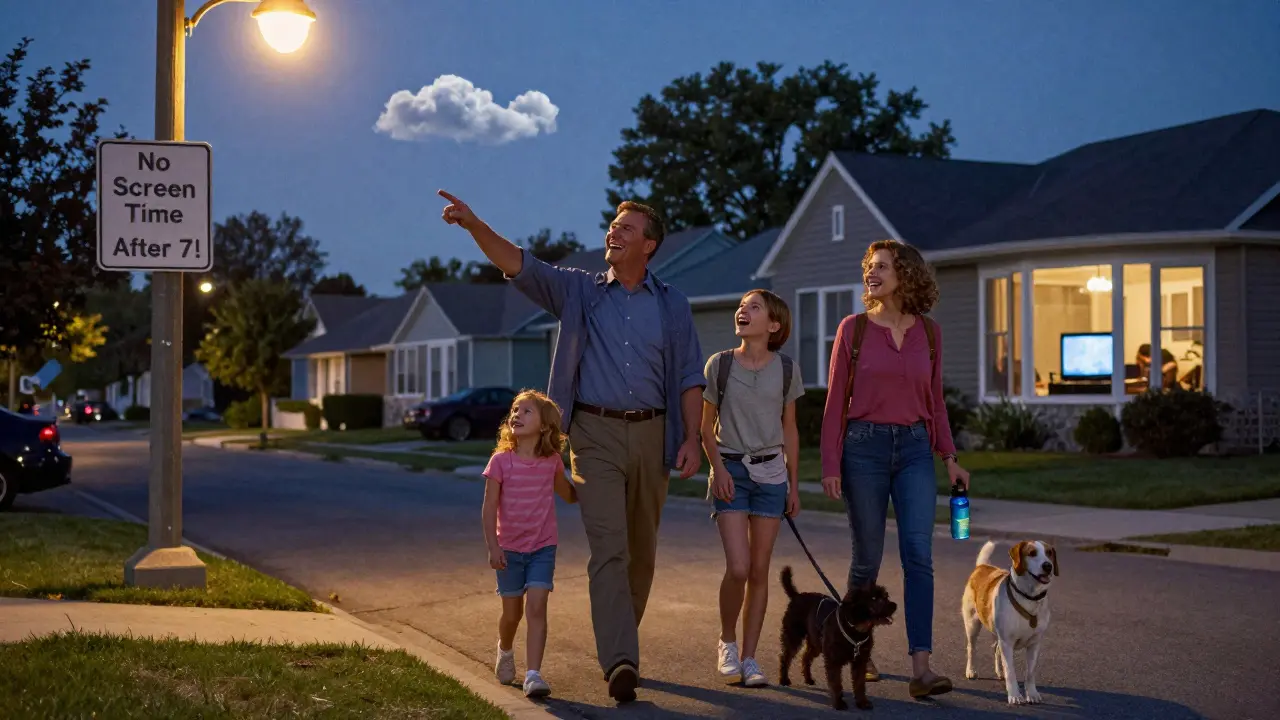
The goal isn’t to turn kids into athletes. It’s to get them moving for at least 60 minutes every day. And it doesn’t have to be structured. Walking the dog, dancing in the kitchen, playing tag after dinner, riding bikes on the weekend-all count.
Screen time is the silent enemy. Research shows reducing it to under two hours a day leads to a 0.8 BMI unit drop over time. That’s like losing 5-7 pounds for an average 10-year-old. And it’s not about punishment. It’s about replacement. If your child is on a tablet after school, what can you do instead? Play a board game. Take a walk. Cook together.
And here’s the secret: kids move more when parents move too. If you’re on the couch scrolling, they’ll be on the floor gaming. If you’re walking after dinner, they’ll follow. Modeling matters more than lectures.
How Family-Based Treatment Actually Works
FBT isn’t a one-size-fits-all program. It’s structured, but flexible. Most programs run for 6 to 24 months, with 16 to 32 sessions total. The 2023 JAMA trial used 26 sessions over two years, delivered by certified health coaches in pediatric clinics-not specialty weight centers.
Here’s what happens in a typical session:
- Food and activity logs - Families track what they eat and how much they move. Not to judge, but to spot patterns. Are they eating snacks after school? Skipping breakfast? Watching TV during meals?
- Parenting skills - How to say “no” to sugary snacks without a meltdown. How to praise effort, not just results. How to set consistent meal and bedtime routines.
- Social facilitation - Planning for parties, holidays, school events. What to bring. What to say to relatives who say, “Just let him have a piece of cake.”
- Progress tracking - Weight is monitored, but so are behaviors: “Did you eat 3 green foods today?” “Did you get 60 minutes of movement?”
Most families don’t complete all 26 sessions. The average is 19.7. That’s okay. What matters is consistency, not perfection. The goal isn’t to hit a number on the scale-it’s to build a new normal.
What About Siblings? And What About Parents?
One of the most surprising findings from FBT research is that siblings who aren’t even part of the program often lose weight too. Why? Because the whole household changes. The fridge is stocked differently. Dinner is eaten together. Screen time is limited. Kids don’t have to be the only one making sacrifices.
And parents? They’re not just helpers-they’re participants. In the same JAMA trial, parents lost weight too. That’s not a side effect. It’s the point. When parents model healthy habits, kids don’t feel like they’re being punished. They feel like they’re part of a team.
“When parents can see their own benefit in addition to the child, then it’s easier for them to be a role model,” says Dr. Stephen Cook from the University of Rochester. That’s why FBT includes goal-setting for adults too: drink more water, take the stairs, sleep 7 hours.
Why Most Programs Fail (And How to Avoid It)
Not every family succeeds. And it’s not because they don’t care. The biggest roadblocks are real:
- Scheduling conflicts - 38% of families say they can’t find time for weekly sessions. Solution: Look for programs integrated into pediatric visits, not separate clinics.
- Parental resistance - 29% of parents don’t want to change their own habits. Solution: Start small. Swap one soda for water. Walk after dinner twice a week. Build momentum.
- Cost and access - Specialty clinics are far away, expensive, and have long wait times. Solution: Ask your pediatrician if they offer coached care. The JAMA trial showed 87% of families completed at least 12 sessions in primary care-compared to 63% in specialty settings.
- Cultural disconnect - Many programs don’t speak Spanish, don’t include traditional foods, or assume all families eat three meals a day. Solution: Demand culturally adapted programs. Ask: “Do you have materials in my language? Can we include my family’s meals?”
The most successful families don’t try to overhaul everything at once. They pick one thing: no sugary drinks. Family dinners 4 nights a week. 20 minutes of movement after school. Master that. Then add the next.

When FBT Isn’t Enough
FBT works for most kids. But not all. If a child has severe obesity-BMI above 120% of the 95th percentile-FBT alone often isn’t enough. Studies show 40% of these kids lose less than 5% of their weight with lifestyle changes alone.
That’s when doctors may recommend additional tools:
- Medication - For teens 12 and older, FDA-approved drugs like semaglutide or liraglutide can help when combined with lifestyle changes.
- Surgery - For adolescents with extreme obesity and related health problems, metabolic surgery is a safe and effective option when guided by a multidisciplinary team.
These aren’t “last resorts.” They’re part of the toolkit. And they work best when paired with FBT. Because even with medication, if the family environment hasn’t changed, the weight comes back.
What’s Next? The Future of Childhood Obesity Care
Change is coming. In 2023, the American Academy of Pediatrics updated its guidelines to recommend FBT for kids as young as 2. Insurance companies are starting to cover it. Medicare and Medicaid now reimburse for intensive behavioral therapy for obesity (G0447 code), though less than 5% of eligible kids are getting it.
Why? Because most pediatric offices aren’t set up for it. It takes training. It takes time. It takes tech. But the tide is turning. Hybrid models-mixing in-person sessions with apps that track meals and movement-are showing 32% higher engagement. Digital tools help families stay on track between visits.
And funding is growing. The 2023 Inflation Reduction Act included community obesity prevention programs. The NIH is funding $4.2 million to study how family communication patterns affect weight outcomes. This isn’t just about weight. It’s about family dynamics, mental health, and long-term well-being.
Where to Start Today
You don’t need a program to begin. You just need to start.
- Remove sugary drinks - Soda, juice, sports drinks. Replace with water, milk, or unsweetened tea. This alone can drop a child’s BMI by 1.0 unit in a year.
- Eat meals together - Even 3 nights a week. No screens. Just conversation.
- Set a 2-hour screen limit - Use a timer. Let the whole family know.
- Move for 20 minutes after dinner - Walk, dance, play catch. Make it fun.
- Ask your pediatrician - “Do you offer family-based obesity treatment here?” If not, ask for a referral.
Small steps, repeated, create big change. You’re not fixing a broken child. You’re building a healthier family.
Is childhood obesity just about eating too much?
No. While diet plays a role, childhood obesity is caused by a mix of factors: genetics, lack of physical activity, screen time, sleep patterns, stress, and the home environment. Blaming a child for eating too much ignores the systems that shape their choices. Family-based treatment works because it changes the environment, not just the child’s behavior.
Can I do family-based treatment at home without a program?
Yes, you can start right now using the Stoplight Diet, limiting screen time, eating meals together, and increasing daily movement. But formal FBT programs provide structure, coaching, and accountability that most families can’t replicate alone. Think of it like learning to drive: you can practice on your own, but a licensed instructor gets you there faster and safer.
How long does family-based treatment take to work?
Most families see changes in 3 to 6 months, especially in eating habits and activity levels. Weight loss may be slower-sometimes just 1 to 2 pounds per month-but that’s healthy and sustainable. The goal isn’t quick fixes. It’s lifelong habits. The strongest results show up after 12 to 24 months.
What if my child resists the changes?
Resistance is normal. The key is to avoid power struggles. Instead of saying, “You can’t have that,” try, “Let’s pick a green light snack together.” Involve your child in meal planning. Let them choose a new vegetable to try. Make movement fun-dance parties, scavenger hunts, bike rides. When kids feel in control, they’re more likely to cooperate.
Does insurance cover family-based treatment?
Yes, under Medicare and Medicaid, insurance covers Intensive Behavioral Therapy (IBT) for obesity using code G0447. Many private insurers do too, but you may need to ask. Ask your pediatrician if they offer FBT and whether they bill insurance. If they don’t, request a referral to a provider who does. Coverage is expanding, but you often have to push for it.
Are there FBT programs for families who speak Spanish or other languages?
Yes, but they’re not always easy to find. Look for community health centers, public hospitals, or programs run by universities. Ask if materials are available in your language. Some programs, like those in California and Texas, offer bilingual coaches. If you can’t find one, ask your pediatrician to connect you with a translator or culturally adapted resources. Language matters-treatment won’t work if families don’t understand it.
Final Thought: This Isn’t About Weight. It’s About Hope.
Childhood obesity isn’t a moral failure. It’s a system failure. And fixing it doesn’t require perfection. It requires presence. It requires parents who are willing to change their own habits. It requires schools that serve real food. It requires clinics that offer real help-not just advice.
Every child deserves to grow up without shame, without chronic disease, without the weight of a world that told them they were the problem. The solution isn’t in a pill or a surgery. It’s in the kitchen, at the dinner table, on the walk home from school. It’s in the hands of parents who say, “We’re doing this together.”




Martin Viau
31 December 2025Let’s be real-this whole FBT framework is just neoliberal boilerplate dressed up as ‘evidence-based.’ You’re telling me we need 26 sessions and a certified coach to get families to stop buying soda? The real problem is food deserts, corporate lobbying, and the USDA’s subsidized corn syrup industry. We’re pathologizing poverty while letting Big Food off the hook. The Stoplight Diet? Cute. But when your kid’s lunch is a $1.50 Taco Bell combo because that’s all SNAP covers, green lights don’t matter. This is systemic failure, not parental incompetence.
And don’t get me started on ‘modeling behavior.’ My cousin works two jobs and still makes it to soccer practice. You think he’s got time to dance after dinner? This whole post reads like a TED Talk written by someone who’s never missed a meal.
Also, why is everyone assuming nuclear families? What about single moms? Grandparents raising kids? FBT assumes a level of stability most low-income households don’t have. It’s not that they don’t care-it’s that they’re drowning.
Stop blaming the parents. Start taxing soda. Ban junk food ads targeted at kids. Pay pediatricians to actually do preventive care instead of waiting until the kid’s pre-diabetic. That’s what ‘works.’ Not cookie-cutter behavior mods.
Also, why is the JAMA study the only thing cited? Where’s the data on cultural relevance? Or the fact that Hispanic families often rely on traditional fried foods as comfort? You can’t just slap ‘red light’ on tamales and call it a day.
And why is the solution always individual behavior change? We’re not fixing the environment. We’re just making poor people feel guilty while the rich buy organic kale smoothies and call it ‘lifestyle.’
Bennett Ryynanen
31 December 2025Y’all are overcomplicating this. My kid was obese at 8. We didn’t do therapy. We didn’t buy apps. We just stopped buying junk. No more soda. No more chips. No more fast food. We made fruit snacks a thing. Walked after dinner. Turned off the TV. That’s it.
First week? He cried. Second week? He complained. Third week? He asked for water instead of juice.
Now he’s 12. Plays basketball. Sleeps through the night. Doesn’t get bullied at school. It’s not magic. It’s consistency. You don’t need a program. You need to care enough to say no.
And yeah, I lost weight too. Didn’t even try. Just stopped eating like a pig.
Stop overthinking. Start doing.
And if your kid’s still fat after six months? Maybe you’re not trying hard enough.
PS: I’m not a saint. I used to be the guy eating pizza in the car. I changed. So can you.
Chandreson Chandreas
2 January 2026Man… this hit different 🌱
I’m from a village in India where kids run barefoot till 10, eat rice with lentils, and drink coconut water. Obesity? Rare. Now? Kids are sipping energy drinks in school uniforms. Same global forces-ads, processed food, screen addiction.
But here’s the thing-FBT works because it’s not about weight. It’s about rhythm. Eating together. Moving together. Sleeping together. That’s the real medicine.
My cousin’s kid in Texas? Same story. Mom works nights. Dad’s gone. Grandpa gives candy to keep peace. The kid’s got prediabetes at 9.
It’s not the kid’s fault. It’s the silence in the house.
Change the rhythm. Not the plate.
And hey… if you’re reading this and thinking ‘I don’t have time’-you’ve got 20 minutes. Walk. Talk. Laugh. That’s the cure.
❤️💛💚
Darren Pearson
3 January 2026While the sentiment behind family-based treatment is laudable, the empirical foundation presented here is dangerously reductive. The JAMA Network Open study cited-while methodologically sound in its RCT design-fails to account for confounding socioeconomic variables, particularly in its control group. The 12.3% excess weight loss metric is statistically significant, yes, but clinically? Marginal. BMI is a flawed proxy for metabolic health, and the normalization of weight loss as a primary endpoint perpetuates fatphobic paradigms in medical discourse.
Furthermore, the Stoplight Diet, while intuitively appealing, lacks granularity in macronutrient and glycemic index considerations. It reduces nutritional science to a color-coded cartoon, which may be accessible to lay audiences but is antithetical to evidence-based dietary counseling.
And let us not overlook the implicit ableism in prescribing 60 minutes of daily movement as a universal standard. What of children with mobility impairments or chronic pain? The model assumes neurotypical, physically capable subjects-a demographic that does not reflect the full spectrum of pediatric populations.
This is not to dismiss intervention. But we must elevate the discourse beyond feel-good anecdotes and into rigorous, intersectional, biopsychosocial frameworks. Otherwise, we risk pathologizing normal variation under the guise of public health.
Stewart Smith
5 January 2026So… you’re telling me the solution to childhood obesity is… make dinner without the TV?
Wow. Groundbreaking.
My kid’s school serves chicken nuggets for lunch. His teacher says he’s ‘a little chubby.’ His pediatrician says ‘he’ll grow out of it.’ And now I’m supposed to dance after dinner like we’re in a Lifetime movie?
Meanwhile, my paycheck goes to rent, gas, and insulin. The ‘Stoplight Diet’ is just a fancy way of saying ‘eat less, work more.’
But hey, at least we’re not blaming the kid anymore. Progress, I guess.
Also, I lost 15 pounds last year. No FBT. Just stopped eating after 8 PM. And I didn’t even try. Funny how that works.
Anyway, congrats on making poor people feel guilty while ignoring the fact that 70% of fast food chains are in low-income neighborhoods. 🤡
Retha Dungga
5 January 2026this is beautiful honestly like the whole thing
its not about the weight its about the family
we forgot that
we turned kids into problems instead of people
and now we want them to fix themselves
but they dont even have the tools
they just have a fridge full of lies and a screen full of noise
we need to sit together
eat together
talk together
not fix together
just be together
and the weight? it will follow
❤️
Jenny Salmingo
7 January 2026I’m a mom of three. Two are healthy. One struggled with weight since age 5. We didn’t have money for programs. But we did this: we made veggies fun. We called them ‘superfoods.’ We let him pick one new one each week. We ate dinner at the table. No phones. We walked after dinner-just around the block. Five minutes. Every night.
He didn’t lose weight fast. But he started sleeping better. Stopped saying he was ‘too tired’ to play. Started asking for water.
It wasn’t perfect. Some nights we ate pizza. Some nights we cried. But we showed up.
And now? He’s 14. He’s not ‘thin.’ But he’s healthy. Happy. Strong.
It’s not about the scale. It’s about showing up. Together.
You don’t need a program. You just need to love them enough to try.
And if you’re tired? So am I. But we’re still here.
And that’s enough.
Frank SSS
8 January 2026Oh wow. Another ‘family-based’ miracle cure. Let me guess-you’re the type who thinks if you just ‘eat clean’ and ‘move more,’ you’ll magically become a 20-year-old Instagram model? 🤡
Here’s the truth no one wants to say: childhood obesity is genetic. It’s hormonal. It’s stress. It’s sleep deprivation. It’s the trauma of being a kid in a broken system. You can’t ‘behavior-mod’ your way out of a thyroid disorder.
And let’s talk about the ‘parents lost weight too’ thing. Oh, great. So now we’re making adults feel guilty for being fat while pretending their kid’s weight is their fault? Brilliant. Let’s just shame the whole family into compliance.
And the Stoplight Diet? That’s not nutrition. That’s a preschool coloring book. Green = good. Red = evil. You think a 7-year-old understands glycemic load? Or insulin resistance? Or leptin signaling?
Meanwhile, the real solution-medication, surgery, trauma-informed care-is buried under this feel-good, middle-class fantasy of ‘family dinners.’
And don’t even get me started on ‘cultural adaptation.’ You can’t just ‘translate’ FBT into Spanish and call it equity. If your program doesn’t include tamales, collard greens, and rice and beans as green lights, you’re not helping-you’re erasing.
Stop pretending this is science. It’s therapy for people who can’t afford to be honest about how broken this system is.
And yeah, I’ve seen kids with severe obesity who ate kale and still gained weight. Because biology doesn’t care about your Pinterest board.
So yeah. Keep dancing after dinner. Meanwhile, the kids with real problems? They’re still waiting for a doctor who’ll listen.