
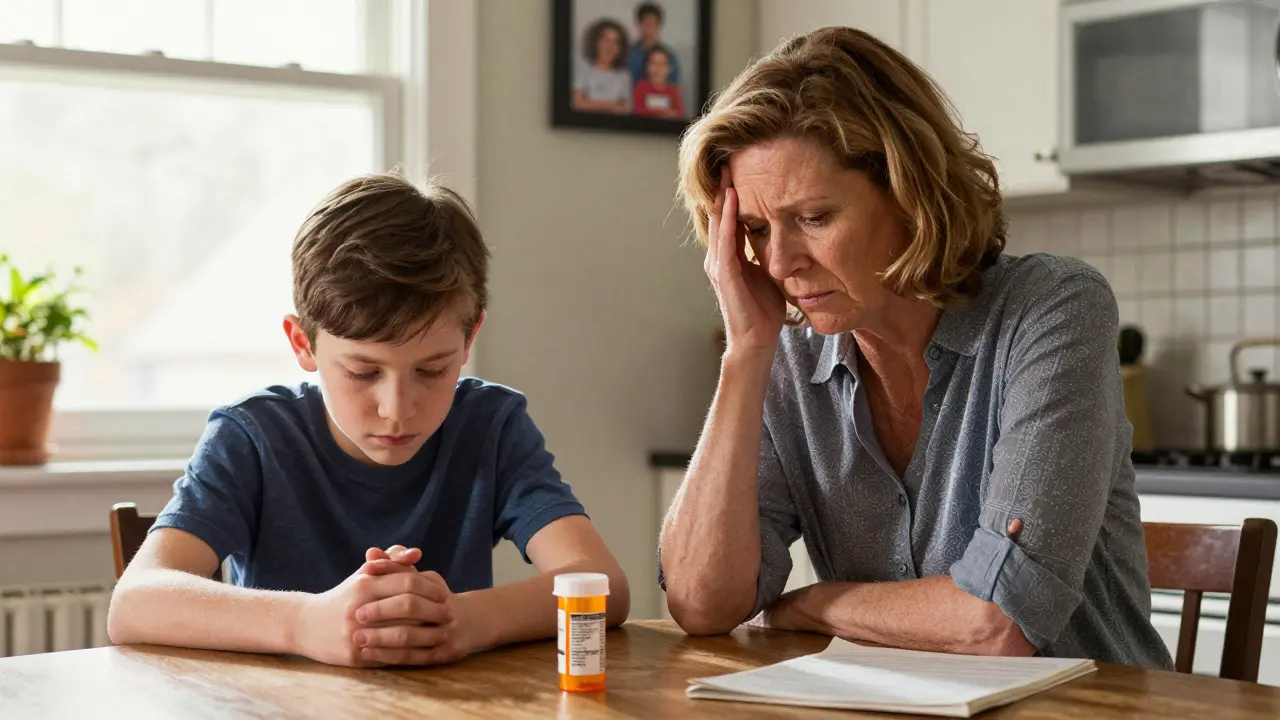

When a teenager starts taking an antidepressant, parents often feel caught between two fears: the crushing weight of untreated depression, and the stark warning printed in bold black borders on the medication bottle. The black box warning on antidepressants for children and teens isn’t just a footnote-it’s the strongest safety alert the FDA can issue. It tells families that these drugs might increase the risk of suicidal thoughts and behaviors in young people. But here’s what no one tells you upfront: the warning, meant to protect, may have done more harm than good.
What the Black Box Warning Actually Says
The FDA first issued this warning in 2003 as a health advisory, then made it official in January 2005. It applies to all prescription antidepressants-whether they’re SSRIs like Prozac or Zoloft, or other types like SNRIs. The exact language on the label says: "Antidepressants increase the risk of suicidal thinking and behavior (suicidality) in children and adolescents with major depressive disorder and other psychiatric disorders." It doesn’t say how often this happens. It doesn’t say which drugs are riskier. It doesn’t set a time limit or dosage threshold. It just says: monitor closely. And that’s where things get messy.The original data came from 24 short-term clinical trials involving over 4,400 kids and teens. In those studies, about 4% of those on antidepressants had suicidal thoughts or behaviors-twice the rate of those on placebo. But here’s the critical detail: no one died. Not a single completed suicide occurred in any of those trials. The warning was based on suicidal ideation and non-lethal actions, not death.
What Happened After the Warning Went Live
The FDA expected doctors to be more careful. Parents would ask more questions. Kids would get better monitoring. What they didn’t expect was a massive drop in prescriptions.Within two years of the 2005 warning, antidepressant prescriptions for 10- to 19-year-olds dropped by 31%. That’s over a million fewer prescriptions per year. By 2007, when the warning was expanded to include young adults up to age 24, prescriptions for that group fell another 25%. Meanwhile, diagnoses of depression in teens were going up-not down. More kids needed help. Fewer were getting it.
The consequences weren’t theoretical. A 2023 study published in Health Affairs tracked over 2.5 million young people across U.S. health plans. They found that in the two years after the 2005 warning, poisonings from psychotropic drugs-used as a proxy for suicide attempts-jumped by 21.7%. After the 2007 expansion to young adults, that number rose 33.7%. At the same time, suicide rates among 10- to 19-year-olds climbed from 2.0 to 3.5 per 100,000-a 75% increase.
And here’s the kicker: suicide rates in adults over 25, who weren’t affected by the warning, didn’t rise the same way. That suggests the drop in treatment, not the illness itself, was driving the spike in deaths.
Doctors Are Struggling to Keep Up
The warning says: "Monitor patients closely." But what does that actually mean in a real clinic?A 2019 survey of 1,200 child psychiatrists found that 87% said the warning made prescribing antidepressants harder. Parents were scared. Some refused medication outright. Others demanded weekly check-ins, even though most clinics don’t have the staffing for that.
Before the warning, doctors spent about 8 minutes per patient explaining risks. Afterward? That jumped to over 22 minutes. That’s nearly three times as long. And even then, only 37% of kids got the recommended monitoring schedule. In rural areas, it was worse-just 22% received proper follow-up.
Doctors now have to sign extra consent forms, fill out more paperwork, and spend hours reassuring families. Many say they avoid prescribing antidepressants altogether-not because they think the drugs are dangerous, but because the system isn’t built to handle the monitoring the warning demands.
The Global Picture: Not Everyone Agrees
The U.S. isn’t the only country dealing with this. But the rest of the world is doing it differently.Canada has a similar warning, but it includes language about balancing risks and benefits. The European Medicines Agency never issued a black box warning for antidepressants in youth. And guess what? European countries didn’t see the same spike in teen suicides after 2005. In fact, some saw rates stabilize or even decline.
That’s not coincidence. Researchers like Dr. Göran Isacsson in Sweden analyzed over 800 teen suicides between 1992 and 2010. He found that after the warning, more suicidal teens went untreated. "The warning," he wrote, "may have increased young suicides by leaving a number of suicidal young persons without treatment."
Meanwhile, pharmaceutical companies like Eli Lilly and Pfizer have formally asked the FDA to revise the warning. They argue it’s too broad, too scary, and not backed by real-world outcomes.
What Parents Are Really Thinking
On Reddit, a thread titled "FDA Black Box Warning on Antidepressants for Teens-Should I be worried?" had over 280 comments. Two-thirds of parents said they were too scared to give their child medication. One wrote: "I’d rather see my daughter suffer than risk her trying to kill herself because of a pill." But another 32% shared different stories. "My son was suicidal before Prozac. After six weeks, he smiled again. The warning made us check in daily-and that’s what saved him." A 2021 survey by the National Alliance on Mental Illness found that among families who did start treatment despite the warning, 67% reported positive outcomes. The key factor? Consistent follow-up. Families who checked in weekly, tracked mood changes, and communicated openly with their doctor saw better results.
Is the Warning Still Necessary?
The FDA still stands by the warning. They say the clinical data is clear: antidepressants carry a small but real risk. That’s true. But science isn’t just about what happens in a controlled trial. It’s about what happens in the real world.When you take away treatment from thousands of depressed teens because of a warning meant to protect them-and suicide rates rise-you have to ask: is the warning working as intended? Or is it creating a new kind of harm?
In June 2022, the American College of Neuropsychopharmacology called for a "careful reassessment" of the warning. In September 2023, the FDA held a public meeting to review the evidence. No decision has been made yet. But researchers agree on one thing: the current warning is outdated. It doesn’t help doctors make better decisions. It just scares families.
The future might lie in smarter tools. The National Institute of Mental Health is working on risk stratification models-ways to identify which teens are truly at higher risk for suicidal behavior on antidepressants, and which aren’t. Early results are expected in 2024. Until then, the warning remains, blunt and unchanging, on every bottle.
What You Should Do If Your Child Needs Treatment
If your child is struggling with depression, here’s what actually matters:- Don’t refuse treatment out of fear. Untreated depression kills. More than antidepressants ever have.
- Ask your doctor: "What’s the risk of NOT treating this?" The answer might surprise you.
- Insist on weekly check-ins for the first month. Even if the clinic doesn’t offer them, push for them. Call. Text. Show up.
- Watch for changes. Increased agitation, withdrawal, sleeplessness, or talk of hopelessness are red flags-no matter if they’re on medication or not.
- Combine meds with therapy. CBT and other evidence-based therapies reduce suicide risk more than meds alone.
The black box warning isn’t a reason to avoid antidepressants. It’s a reason to be smarter about using them. It’s not about avoiding risk-it’s about managing it.
Do antidepressants cause suicide in teens?
No, antidepressants do not cause suicide. But in a small number of teens and young adults, they may increase suicidal thoughts or behaviors during the first few weeks of treatment. In clinical trials, this happened in about 4% of those on medication versus 2% on placebo. No completed suicides occurred in those studies. The bigger risk comes when depression goes untreated.
Why did the FDA issue the black box warning?
The FDA issued the warning based on data from 24 clinical trials showing a small increase in suicidal thoughts and behaviors in children and teens taking antidepressants. The goal was to make doctors and families more aware of the risk so they could monitor patients closely. The warning was expanded in 2007 to include young adults up to age 24.
Has the black box warning reduced teen suicides?
No. Research shows the opposite. After the warning was issued, antidepressant prescriptions dropped sharply-and teen suicide rates rose. A 2023 study found suicide attempts (measured by drug poisonings) increased by over 20% in the two years after the warning. Experts now believe the warning may have done more harm than good by discouraging treatment.
Are some antidepressants safer than others for teens?
The FDA warning applies to all antidepressants, but research suggests some may carry slightly different risks. For example, fluoxetine (Prozac) has the most evidence supporting its safety and effectiveness in teens. Other SSRIs like sertraline (Zoloft) and escitalopram (Lexapro) are also commonly used. But no antidepressant is risk-free. The key isn’t which drug-it’s how closely the patient is monitored.
Should I avoid antidepressants for my child completely?
No. For many teens with moderate to severe depression, antidepressants are life-saving. The risk of suicide from untreated depression is far greater than the risk from medication. The goal isn’t to avoid medication-it’s to use it safely. That means working with a doctor, starting with low doses, monitoring closely for changes, and combining treatment with therapy.
What should I do if my child starts acting differently after beginning antidepressants?
Contact your doctor immediately. Changes like increased agitation, panic attacks, sleeplessness, talk of death or self-harm, or sudden withdrawal are warning signs. Don’t stop the medication on your own-sudden discontinuation can make things worse. Your doctor may adjust the dose, switch medications, or add therapy. The first month is the most critical time for monitoring.
What Comes Next
The black box warning was created with good intentions. But medicine isn’t just about data from trials-it’s about what happens when that data meets real lives. Right now, thousands of teens are going without treatment because they’re afraid of a warning that doesn’t reflect the full picture.The FDA is reviewing the evidence. Researchers are building better tools. Doctors are pushing back. And families? They’re just trying to keep their kids alive.
What’s needed isn’t more fear. It’s better guidance. Clearer communication. And a system that supports treatment-not blocks it.



Gabriella da Silva Mendes
22 December 2025OMG I CAN’T BELIEVE THEY’RE STILL USING THIS WARNING 😭 Like, seriously? My cousin took Zoloft at 16 and went from crying in bed all day to playing guitar and getting A’s. Now they’re scared to even *talk* about meds? 🤦♀️ The real tragedy is kids dying because parents are too scared to listen to doctors. The FDA needs to get off their high horse and look at REAL data, not 2005 lab numbers. #StopScaringParents #AntidepressantsSaveLives
Kiranjit Kaur
23 December 2025This is such an important post 💙 I’m from India, and here, mental health is still taboo. Many teens suffer silently because families think ‘it’s just a phase’. But when treatment is offered - even with warnings - it changes lives. The black box warning feels like a blanket fear tactic. We need nuance, not panic. A teen who smiles again after medication? That’s not a risk. That’s a miracle.
Sam Black
25 December 2025As someone who’s worked in pediatric psych for 12 years - this is spot on. The warning wasn’t designed to scare families into inaction. But that’s exactly what happened. I’ve had parents cry and say, ‘I’d rather see my kid sad than dead.’ But sadness isn’t death. And untreated depression? That’s a slow-motion suicide. We need better tools, not more fear. The data’s clear: monitoring works. We just need the system to support it.
Cara Hritz
27 December 2025ok so i read this whole thing and i think the fda is just being overcautious but also like… why are we even giving antidepressants to teens? shouldn’t we just fix their lives? like school stress, social media, toxic parents? maybe they just need a new bedroom or less homework? 🤔 also i think the suicide stats are fake because the government lies. #DeepStateMedicine
Jamison Kissh
28 December 2025There’s a philosophical tension here that’s rarely acknowledged: the FDA’s duty is to prevent harm, but harm isn’t only physical. Psychological harm - the erosion of hope, the silence of a child who stops speaking - is also harm. The warning, in its rigid form, treats risk as binary: drug = danger. But life isn’t binary. The real ethical question isn’t ‘Do antidepressants cause suicide?’ It’s ‘Does refusing treatment cause more suffering than the drug ever could?’
Tony Du bled
29 December 2025Man, I remember when my sister started Prozac. We had to go to the clinic every week for a month. It was a pain, but it worked. She’s 28 now, has a job, a dog, and doesn’t cry in the shower anymore. The warning’s not wrong - it’s just incomplete. It doesn’t say ‘but this might save your kid’s life.’ That’s the part nobody talks about.
Candy Cotton
30 December 2025It is imperative to acknowledge that the Food and Drug Administration, as a regulatory body of the United States of America, operates with the highest standards of scientific rigor and public safety. The issuance of the black box warning was not arbitrary, but predicated upon statistically significant data derived from controlled clinical trials. To suggest that this warning has caused harm is not merely speculative - it is an affront to evidence-based medicine and the foundational principles of public health oversight.
Ajay Brahmandam
1 January 2026My brother took Lexapro at 17. First two weeks, he was jittery. Then he started laughing again. We called his doctor every 3 days. No crisis. Just progress. The problem isn’t the meds - it’s the system. No one has time to monitor. No one has money to pay for weekly visits. The warning is fine. The lack of support? That’s the real killer.
jenny guachamboza
2 January 2026THEY’RE HIDING SOMETHING. WHY DID THE PHARMA COMPANIES ASK FOR THE WARNING TO BE CHANGED? 🤫 I looked up Eli Lilly’s stock after 2005 - it went DOWN. Coincidence? NO. They wanted LESS monitoring so they could sell MORE pills. And now the government’s using fear to control us. Kids are being drugged to keep them quiet. I read the trials - 4% is a lie. It’s 12%. They just don’t want you to know. #BigPharmaCoverUp 🚨💊
Tarun Sharma
4 January 2026Respectfully, the clinical data supports caution. The warning is not a ban. It is a call for vigilance. To dismiss it entirely risks undermining the integrity of medical ethics. Monitoring, when properly implemented, reduces harm. The issue is not the warning - it is the lack of infrastructure to uphold it.
Aliyu Sani
4 January 2026Look, I’ve seen this in Lagos - kids with depression get no help, period. No meds, no therapy, just ‘pray harder’. So when the U.S. has a warning and still sees suicide spikes? That’s not the drug’s fault. That’s the system failing. The warning’s a bandaid on a gunshot wound. We need access, not fear. And we need to stop acting like this is a ‘Western problem’ - it’s a human one.
Jim Brown
5 January 2026There’s a quiet irony here: we’ve created a system where the most vulnerable are punished by the very safeguards meant to protect them. The black box warning is a moral artifact - born of good intent, but frozen in time. It speaks to the risk of action, but ignores the risk of inaction. In ethics, sometimes the greater sin is not doing something, not doing it wrong. We must ask not just ‘Is it dangerous?’ but ‘What is the cost of silence?’
Sai Keerthan Reddy Proddatoori
7 January 2026They say the warning caused more deaths? That’s just woke propaganda. Real Americans don’t need pills to be happy. Back in my day, we dealt with sadness by working harder, going to church, and talking to our dads. Now kids get a prescription and a trophy for being sad. This is why our country is falling apart. Stop drugging our youth. Teach them resilience.
Johnnie R. Bailey
8 January 2026Let’s not pretend this is just about pills. It’s about access. It’s about time. It’s about whether a rural teen in Nebraska can get a follow-up call after a prescription. The warning isn’t the villain - the lack of mental health infrastructure is. We can’t fix this with a new label. We need more therapists, more funding, more training. And we need to stop treating depression like a moral failure.
Art Van Gelder
9 January 2026I sat in a waiting room for 90 minutes once just to get a script for my daughter. The doctor looked at me like I was asking for a unicorn. "We don’t have the time to monitor her." I cried in my car. Then I drove to the pharmacy, bought the meds, and watched her sleep for three days straight. She didn’t die. She got better. But the system? It almost killed us both. This warning isn’t protecting anyone - it’s just making doctors too scared to help. And that’s the real tragedy.