
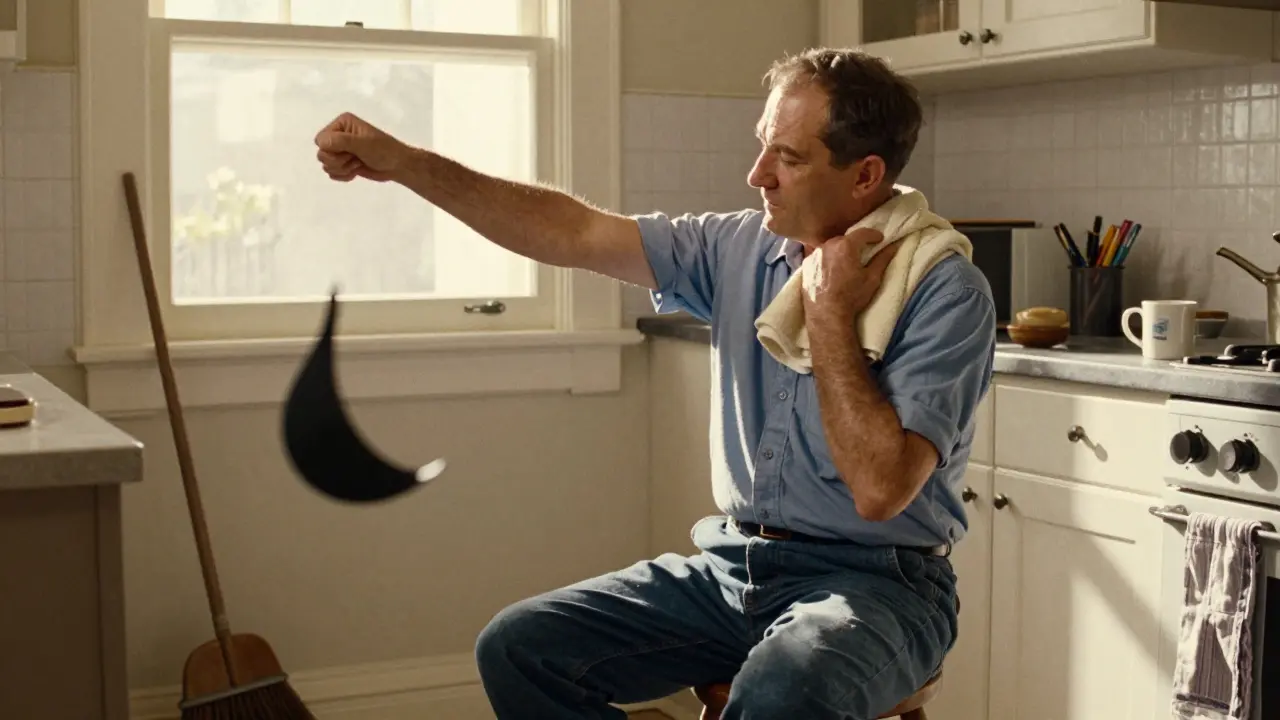

When your shoulder starts hurting and won’t move-not even a little-it’s easy to assume it’s just a bad strain or overuse. But if the pain builds slowly, gets worse at night, and your arm feels locked in place no matter how hard you try to reach overhead or behind your back, you might be dealing with something more specific: frozen shoulder, or adhesive capsulitis.
This isn’t just stiffness. It’s a full-body condition where the shoulder joint capsule-the tough, flexible tissue that holds the ball-and-socket joint together-thickens, tightens, and loses its stretch. The result? Pain that creeps in over weeks, then stiffness that feels like your shoulder’s been glued shut. And while it can last up to three years on its own, you don’t have to wait it out.
What’s Really Happening Inside Your Shoulder?
The shoulder joint is designed to move in all directions. It’s the most mobile joint in your body, held together by a loose, stretchy capsule filled with fluid. In frozen shoulder, that capsule shrinks. Studies show it can lose nearly half its volume-from 30-35 mL down to just 10-15 mL. That’s like trying to fit your hand into a glove two sizes too small.
The thickening happens mostly in the front and top of the capsule, especially around the axillary recess and coracohumeral ligament. This isn’t caused by adhesions sticking tissues together, despite the name. It’s more like scar tissue forming inside the capsule, making it stiff and unyielding. The inflammation that kicks things off eventually turns into fibrosis-dense, inflexible tissue that doesn’t stretch.
What makes this condition unique is that both active movement (you moving your arm) and passive movement (someone else moving your arm) are equally limited. That’s different from a rotator cuff tear, where you might not be able to lift your arm on your own, but someone else can still move it freely. In frozen shoulder, no one can move it-because the whole joint is stuck.
The Three Stages: Pain, Stiffness, and Slow Return
Frozen shoulder doesn’t hit all at once. It follows a clear pattern, usually over 1 to 3 years. Knowing which stage you’re in helps you choose the right treatment.
- Freezing stage (6 weeks to 9 months): Pain starts slowly, gets worse at night, and spreads across the shoulder and upper arm. Movement becomes harder, but the real problem is the pain. You might avoid using the arm because every motion feels like a sharp jab.
- Frozen stage (4 to 6 months): The pain fades a bit, but stiffness takes over. You can’t reach behind your back, comb your hair, or put your hand in your back pocket. External rotation-the ability to turn your palm up-is the first to go, often reduced by 60-70%. This is the stage where people say, “It doesn’t hurt anymore, but I just can’t move it.”
- Thawing stage (6 months to 2 years): Movement slowly comes back. Not all at once, but little by little. Some people regain full motion. Others are left with a small permanent loss, especially in rotation.
Here’s the key: you can’t rush this. Pushing too hard during the freezing phase can make the inflammation worse. But doing nothing means you’re stuck in the frozen stage longer than you need to be.
Who’s Most at Risk?
Frozen shoulder affects 2-5% of the general population, but that number jumps to 10-20% in people with diabetes. Why? High blood sugar changes how collagen (the main protein in connective tissue) behaves, making it more likely to stiffen. It’s also more common in people over 40, women, and those who’ve had shoulder surgery, a heart attack, or prolonged immobilization-like after a broken arm or stroke.
It’s not caused by lifting too much or sleeping wrong. There’s no single trigger. That’s why it’s often misdiagnosed. Around 30-40% of cases in primary care are initially labeled as rotator cuff tendonitis or arthritis. The real clue? The capsular pattern of restriction: external rotation first, then abduction (lifting the arm out to the side), then internal rotation (reaching behind your back). If your doctor sees that pattern, it’s frozen shoulder.

Mobilization Strategies That Actually Work
Here’s the good news: you don’t need surgery to get better. Most people recover fully with the right exercises and timing. But not all exercises are created equal. What works in the freezing stage can hurt you in the frozen stage.
During the Freezing Stage: Gentle Movement, Not Stretching
Pain is your guide. If it hurts, stop. The goal isn’t to stretch-it’s to keep the joint moving enough to prevent further tightening.
- Pendulum exercises: Lean forward, let your arm hang loose. Gently swing it in small circles-like a clock pendulum. Do this for 5 minutes, 2-3 times a day. It’s low-risk and helps maintain some motion without stressing the joint.
- Passive range-of-motion with a wand: Hold a broomstick or cane with both hands. Use your good arm to gently guide the affected arm through small arcs-up, out, and across. Don’t force it. Just move it as far as it goes without pain.
- Heat before movement: Apply a warm towel or heating pad for 10-15 minutes before doing exercises. Heat relaxes the capsule and makes movement easier.
Studies show people who start these gentle moves within 8 weeks of symptoms report 65% less pain at 6 months. Those who wait longer? Only 32% improvement.
During the Frozen Stage: Progressive Stretching
Now the pain has eased. Time to work on regaining motion-but still no forcing.
- Towel stretch: Hold a towel behind your back with both hands. Use your good arm to gently pull the towel upward, bringing the affected arm up and back. Hold for 15-20 seconds. Repeat 3 times.
- Doorway stretch: Stand in a doorway. Place your hand on the frame at shoulder height. Gently lean forward until you feel a stretch in the front of your shoulder. Hold 30 seconds. Repeat 3 times.
- Supine external rotation: Lie on your back. Bend your elbow to 90 degrees. Use your good arm to gently push the affected forearm outward, rotating your palm toward the ceiling. Stop at the point of mild tension-not pain.
These aren’t quick fixes. Progress is slow. One Reddit user reported gaining 20 degrees of external rotation in 4 weeks just by doing daily pendulum exercises before bed. Consistency beats intensity.
What Doesn’t Work (And Can Make Things Worse)
Aggressive stretching during the freezing phase is the #1 mistake. A patient on Cleveland Clinic’s portal shared that forced cross-body stretches turned their 4/10 pain into an 8/10 for three weeks. That’s not progress-that’s injury.
Also skip manipulation under anesthesia (MUA) unless you’ve tried 6 months of physical therapy first. It’s not a shortcut. It carries risks: fractures, torn tendons, nerve damage. Same with corticosteroid injections. Some studies say they help short-term pain. Others show no benefit after 12 weeks. They might give you a few weeks of relief, but they don’t speed up recovery.

Tools and Support
You don’t need fancy gear. A towel, a broomstick, and a doorway are enough to start. But if you want extra help, a $25 shoulder rehab kit with a wand and resistance bands can be useful. Some people use devices like the ShoulderROM, which gives real-time feedback on range of motion. Clinical trials show it can cut recovery time by 32% compared to standard care.
Sleep is a big issue. Seventy-eight percent of people with frozen shoulder wake up because of pain. The fix? Sleep on your back with a pillow under the affected arm. Or, if you sleep on your side, hug a pillow to keep your shoulder in a neutral position.
Online support groups like the Adhesive Capsulitis Support Group on Facebook (with over 12,000 members) are full of people sharing daily routines, progress photos, and tips. You’re not alone.
When to See a Professional
If your shoulder pain came on suddenly after trauma, or if you have fever, weight loss, or night sweats, get checked for infection or cancer. Frozen shoulder doesn’t cause those.
But if your shoulder’s been stiffening over weeks with no clear injury, and your doctor confirms the capsular pattern, see a physical therapist. Supervised therapy during the freezing phase has been shown to speed recovery by 28% compared to home-only programs.
Most insurance plans now cover telehealth physical therapy for shoulder rehab. If you’re employed, check with your HR-41% of large U.S. employers include it in their health benefits.
What to Expect Long-Term
The outlook is good. According to the 2023 Cochrane Review, 87% of people regain full or near-full function within two years. Only 13% end up needing surgery, usually if they’ve had 12+ months of therapy with no progress.
Future research is looking at blood markers like IL-6 to predict who responds best to which therapy. That means someday, your treatment might be personalized based on your body’s inflammation levels.
Right now, though, the best tool you have is time-combined with smart, consistent movement. Don’t panic. Don’t push too hard. Just keep moving, gently, every day. Your shoulder will thank you.




Sue Stone
22 January 2026Been there. Did the pendulum thing with a water bottle. Took six months, but I finally got my hair back in a ponytail. No magic, just daily baby steps.
Also, sleep on your back. Trust me.
Worth it.
Andrew Smirnykh
23 January 2026Interesting how this condition mirrors the body’s tendency to protect itself by shutting down-like emotional withdrawal, but in tissue. The capsule isn’t just stiffening; it’s retreating. Maybe that’s why stress makes it worse. We freeze when we feel trapped, and our shoulders do the same.
Not a metaphor. Just an observation.
Still, the exercises make sense. Gentle motion as a form of re-entrusting the body.
Quiet healing, not forceful repair.
dana torgersen
24 January 2026OMG, I didn’t know it was called adhesive capsulitis… I thought I was just ‘old’ or ‘lazy’… I’ve been avoiding my left shoulder for 14 months!!
And now I’m crying because I just realized I haven’t reached behind my back to scratch my spine since last winter…
Wait-wait-I’m gonna try the towel thing tonight…
Also, why does no one talk about this?!
Why is this not on every doctor’s poster?!
And why did my PT tell me to ‘just stretch it’ like it was a yoga pose?!
Ugh.
Thank you for this.
Also, I’m gonna start sleeping with a pillow under my arm.
And maybe… just maybe… I’ll get my life back.
Thank you.
Thank you.
Thank you.
Stacy Thomes
25 January 2026YESSSSSSSSS. I was in the frozen stage for 11 months and thought I was broken forever. Then I found the doorway stretch. I did it every morning before coffee. No pain. Just slow, quiet progress. Now I can put my hand on my hip. I used to cry trying to reach my bra clasp. I’m not fixed, but I’m not broken anymore. You’re not alone. Keep going. One degree at a time. You got this.
Also, the Facebook group saved my sanity. 12k people? I’m not crazy. I’m just frozen.
And that’s okay.
Anna Pryde-Smith
26 January 2026Why are people still wasting time with ‘gentle’ exercises? I had mine for 18 months and did NOTHING-just waited. Then I went to a specialist and got manipulated under anesthesia. Broke it open. Felt like my shoulder exploded. Was in agony for 3 days. Then-POOF-full range. No more pain. No more waiting. Why are you all still doing pendulums?!
Stop being nice to your shoulder. It doesn’t deserve kindness. It betrayed you.
Break it. Fix it. Move on.
And stop reading blogs. Go to a real doctor.
That’s what I did.
And now I’m free.
Dawson Taylor
26 January 2026The capsular pattern of restriction is pathognomonic. The loss of external rotation precedes abduction and internal rotation. This distinguishes adhesive capsulitis from rotator cuff pathology, wherein passive motion remains intact. The fibrotic transformation of the joint capsule is well-documented in histopathological studies. Non-operative management yields favorable outcomes in the majority of cases, provided progression is stage-appropriate. Aggressive stretching during the freezing phase exacerbates inflammatory cytokine release. Consistency, not intensity, drives recovery.
Consider this: the 2023 Cochrane Review confirms 87% functional recovery without surgical intervention.
Patience is therapeutic.
Sallie Jane Barnes
28 January 2026I’m a physical therapist. I’ve seen this a hundred times. And I’m telling you-don’t skip the freezing stage. Don’t rush. Don’t be the person who tries to ‘crack’ their shoulder open. You’ll regret it.
But also-don’t do nothing. Do the pendulums. Do the wand. Do the heat. Do it every day. Even if you’re tired. Even if you’re sad. Even if it feels pointless.
It’s not pointless.
It’s medicine.
And if you’re diabetic? That’s the #1 red flag. Your body’s already fighting more than you know.
Don’t wait until you can’t reach your phone to call your PT.
Call today.
You’re worth the effort.
And so is your shoulder.
charley lopez
29 January 2026Adhesive capsulitis is characterized by synovial proliferation, fibroblast activation, and extracellular matrix remodeling, resulting in capsular volume reduction. The axillary recess exhibits the most pronounced collagen deposition, correlating with loss of external rotation. Non-operative interventions targeting fibroblast modulation-such as low-load, prolonged stretching-demonstrate efficacy in phase II clinical trials. Corticosteroid injection shows transient anti-inflammatory effect but fails to alter fibrotic trajectory. Mobilization under anesthesia remains a last-resort modality, with complication rates exceeding 5% in elderly cohorts. Evidence supports early physical therapy initiation within 8 weeks of symptom onset to reduce duration by 28% (p < 0.01).
Recommendation: adhere to stage-specific protocols. Avoid anecdotal interventions.