


When your body makes too much cortisol, it doesn’t just make you feel off-it changes your entire body. Cushing’s syndrome isn’t just about weight gain or a round face. It’s a serious endocrine disorder caused by prolonged exposure to high levels of cortisol, a hormone that normally helps you handle stress, regulate blood sugar, and control inflammation. But when it’s constantly overproduced, it breaks down muscle, weakens bones, spikes blood pressure, and can even lead to life-threatening complications. The good news? For many people, surgery can fix it. And for those who get treated early and at the right center, recovery isn’t just possible-it’s often complete.
What Exactly Is Cushing’s Syndrome?
Cushing’s syndrome happens when your body is flooded with cortisol for months or years. Cortisol isn’t bad-it’s essential. But too much of it, especially from your own body (not from pills), causes a cascade of damage. You might notice your face getting rounder, your neck developing a fatty hump, or purple stretch marks appearing on your belly and thighs. These aren’t just cosmetic changes. They’re signs your body is being eaten away from the inside.
There are two main types. About 80% of cases come from taking steroid medications like prednisone for conditions like asthma or arthritis. That’s called exogenous Cushing’s. The other 20% are endogenous-your body is making too much on its own. That’s the kind that needs surgery. It’s rare: only 10 to 15 people out of every million get it each year. But if you’re a woman between 20 and 50, your risk goes up. About 70% of endogenous cases happen in this group.
The source matters. In 60 to 70% of endogenous cases, a small, noncancerous tumor in the pituitary gland (called a microadenoma) is pumping out too much ACTH, which tells your adrenal glands to make more cortisol. This is called Cushing’s disease. In 15 to 20% of cases, a tumor on one adrenal gland makes cortisol directly. Rarely, a tumor elsewhere-like in the lungs or pancreas-makes ACTH, tricking your adrenals into overproduction. These are called ectopic tumors.
How Do You Know If You Have It?
Doctors don’t diagnose Cushing’s by looking at you. They test. And they usually need two or three tests to be sure. The most common ones are:
- Late-night salivary cortisol test: Cortisol should be low at night. If it’s above 0.14 mcg/dL, that’s a red flag.
- 24-hour urine cortisol: Normal is under 50 mcg per day. Levels over that suggest excess production.
- Low-dose dexamethasone suppression test: You take a pill that should shut down cortisol production. If it doesn’t, your body isn’t responding the way it should.
These tests are more reliable than blood tests because cortisol levels naturally swing throughout the day. The real clues come from the physical signs. A moon face? That’s in 70% of patients. A buffalo hump? Almost everyone has it. Violaceous stretch marks wider than a centimeter? That’s seen in 75%. High blood pressure? Affects 85%. Type 2 diabetes or prediabetes? Present in 70%. Bone loss? Half of patients have osteoporosis with a T-score below -2.5.
These aren’t random symptoms. They’re the direct result of cortisol breaking down muscle, storing fat in the wrong places, suppressing immunity, and weakening bones. Left untreated, your risk of heart attack, stroke, or serious infection skyrockets.
Why Surgery Is the First-Line Treatment
Medications exist-drugs like pasireotide or mifepristone can block cortisol or shrink tumors. But they’re not cures. They manage symptoms, cost $5,000 to $10,000 a year, and often come with side effects like nausea, fatigue, or liver issues. Surgery, when possible, is the only way to remove the root cause.
The Endocrine Society’s 2020 guidelines say this clearly: if you have an identifiable tumor causing endogenous Cushing’s, surgery should be your first step. And the data backs it up. For pituitary tumors smaller than 10 mm (microadenomas), transsphenoidal surgery-done through the nose-has a remission rate of 80 to 90%. Even for larger tumors, success rates stay above 50%. For adrenal tumors, removing the affected gland (adrenalectomy) works in 95% of cases.
Dr. Maria Fleseriu, a leading pituitary expert at Oregon Health & Science University, says it plainly: “Transsphenoidal surgery performed by high-volume pituitary surgeons represents the gold standard.” The difference in outcomes is stark. Centers doing fewer than 10 pituitary surgeries a year see remission rates of just 50 to 60%. High-volume centers-those doing 20 or more-see 80 to 90%. That’s not a small gap. It’s the difference between hope and certainty.
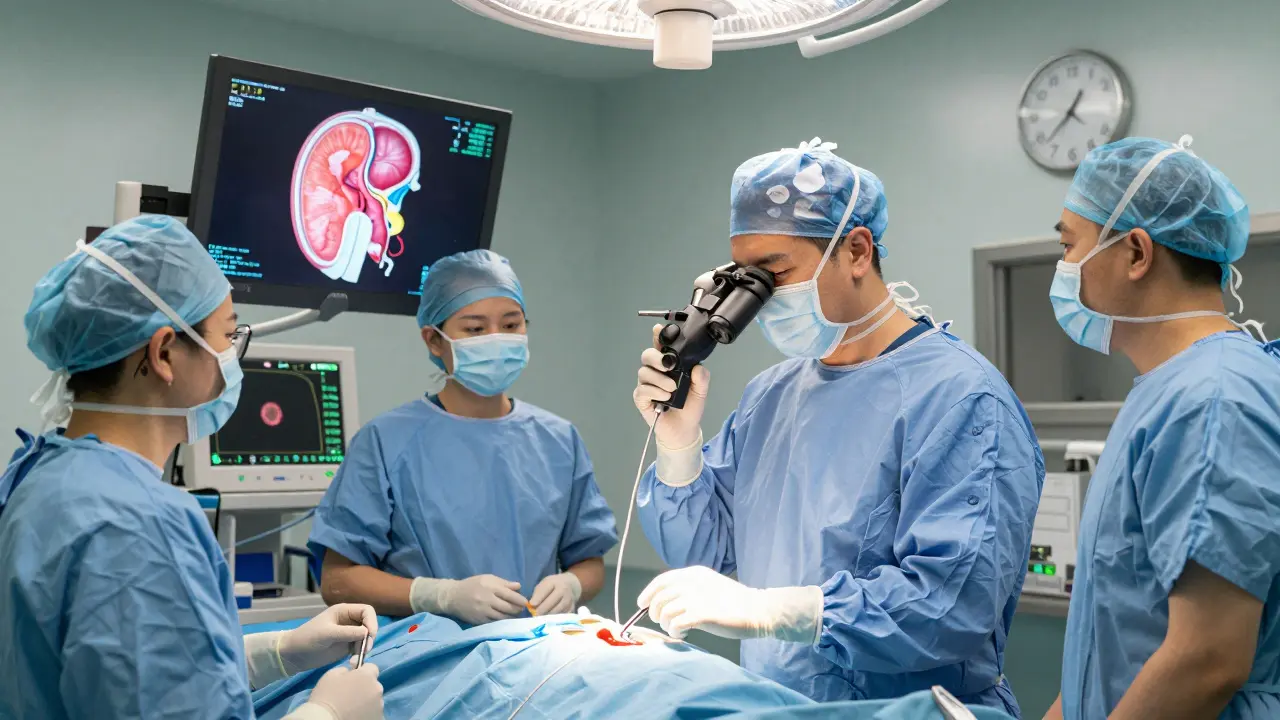
What the Surgeries Look Like
There are two main types of surgery, depending on where the problem is.
Transsphenoidal surgery is for pituitary tumors. A surgeon goes through the nose or upper lip, using a microscope or endoscope to reach the pituitary gland. The procedure takes 2 to 4 hours. Most people are in the hospital for 2 to 5 days. Recovery is quick at first-you can walk the next day-but full energy returns over weeks. New tools like the Neuro-Robotic Scope system, approved by the FDA in 2023, give surgeons 3D, high-resolution views and cut surgical time by 25%. CSF leaks, once common, now happen in only 2 to 5% of cases thanks to better techniques.
Laparoscopic adrenalectomy is for adrenal tumors. Small incisions, a camera, and specialized tools remove the affected gland. It’s less invasive than open surgery. Most patients go home in 1 to 2 days. Recovery is faster than pituitary surgery. Success rates? 95%. Complication rates? Only 2 to 5%.
There’s also bilateral adrenalectomy-removing both adrenal glands. This is a last resort. It cures Cushing’s 100% of the time, but you’ll need lifelong hormone replacement. And there’s a 40% chance of developing Nelson’s syndrome-a fast-growing pituitary tumor that can cause vision loss or hormone imbalances. It’s avoided unless absolutely necessary.
What Happens After Surgery?
Getting the tumor out doesn’t mean your body instantly returns to normal. Your adrenal glands have been told to make cortisol for so long that they’ve gone quiet. After surgery, you go into temporary adrenal insufficiency. Your body needs replacement steroids-usually hydrocortisone-for weeks or months. About 70% of patients need them for 3 to 6 months. 10% need them for life.
That’s not just a pill you take. You have to learn how to adjust doses during stress: illness, injury, surgery, even a bad flu. If you don’t, you risk an adrenal crisis-low blood pressure, vomiting, fainting, even death. That’s why patients at high-volume centers get support from dedicated Cushing’s nurse coordinators. They teach you how to recognize warning signs, carry emergency injectable cortisol, and manage your meds.
It takes time to heal. One patient on the Cushing’s Support & Research Foundation forum wrote: “Two months after surgery, my moon face disappeared, my blood pressure dropped without meds, and I lost 40 pounds.” But another said: “I still battle fatigue and needed thyroid and testosterone replacement after my bilateral adrenalectomy.” Recovery isn’t linear. Fatigue, mood swings, and body image issues linger. But most people-85% according to patient surveys-say their quality of life improves dramatically within a year.

Why Timing and Location Matter
Delaying surgery has real consequences. Dr. Edward Laws, a former president of the American Association of Neurological Surgeons, found that patients who have surgery within two years of diagnosis have 30% higher remission rates than those who wait longer. And the longer you wait, the more damage cortisol does. Bone loss, heart strain, and diabetes get harder to reverse.
That’s why location is everything. Only 15% of patients in the U.S. are treated at specialized centers. Most go to general hospitals where surgeons may only do one or two pituitary cases a year. That’s not enough experience. The result? Lower success, more complications, more repeat surgeries.
Insurance can be a hurdle. Medicare covers about 85% of pituitary surgery costs. But private insurers deny 20% of adrenalectomy requests. Patients often have to fight for approval. The good news? New FDA-approved tools like intraoperative cortisol monitors are cutting hospital stays by two days. That saves money and reduces infection risk.
What’s Next for Cushing’s Treatment?
Technology is changing the game. Molecular imaging with 11C-metomidate PET/CT-still in trials-is making tumors visible that used to be invisible on MRI. That means surgeons can find smaller tumors, remove them more completely, and avoid missing hidden ones.
The NIH’s CUREnet registry, launched in 2022, is tracking over 1,000 patients across 15 centers. Early results show that if surgery happens within 18 months of diagnosis, remission rates hit 85%. Wait beyond two years? It drops to 65%. That’s a powerful reason to act fast.
By 2030, experts predict half of all Cushing’s surgeries will happen at specialized centers with multidisciplinary teams-endocrinologists, neurosurgeons, nurses, and mental health support-all working together. That’s the future. And it’s already starting.
What Should You Do If You Suspect Cushing’s?
If you have unexplained weight gain, high blood pressure, muscle weakness, or skin changes that don’t go away, don’t wait. Ask your doctor about testing. Get referred to an endocrinologist. If Cushing’s is suspected, push for a referral to a center that does at least 20 pituitary surgeries a year. Don’t settle for a general hospital if your case involves a pituitary tumor.
Surgery isn’t risk-free. But for most people with endogenous Cushing’s, it’s the best-and often only-chance to get your life back. The cure isn’t guaranteed, but the odds are good if you go to the right place at the right time. And for many, the results are life-changing.
Can Cushing’s syndrome be cured without surgery?
Medications can help manage symptoms, but they rarely cure the condition. Drugs like pasireotide or mifepristone block cortisol or shrink tumors, but they’re not permanent solutions. They’re used when surgery isn’t possible or while waiting for it. For endogenous Cushing’s caused by a tumor, surgery is the only treatment with a high chance of cure.
How long does recovery take after Cushing’s surgery?
Physical recovery varies. Most people leave the hospital in 1 to 5 days, but full recovery takes 3 to 6 months. Fatigue, mood swings, and muscle weakness linger as your body adjusts to normal cortisol levels. Some patients need steroid replacement for months or even years. Returning to work often takes 6 to 12 weeks, depending on the job and how your body responds.
What are the risks of pituitary surgery for Cushing’s?
Common risks include temporary adrenal insufficiency (affecting 30-40% of patients), headaches, and nasal congestion. More serious but rare risks include cerebrospinal fluid leaks (2-5%), infection (1-3%), and damage to the pituitary gland leading to permanent hormone deficiencies. The risk of complications drops significantly at high-volume centers with experienced surgeons.
Why do some people need lifelong hormone replacement after surgery?
After removing a tumor that caused excess cortisol, the adrenal glands often stop working temporarily-or permanently-because they’ve been suppressed for so long. In some cases, especially after bilateral adrenalectomy, the glands are removed entirely. That means you’ll need daily replacement of cortisol (hydrocortisone) and sometimes aldosterone (fludrocortisone) for the rest of your life.
Is Cushing’s syndrome more common in women?
Yes. About 70% of endogenous Cushing’s cases occur in women between the ages of 20 and 50. The reason isn’t fully understood, but hormones and immune system differences may play a role. Pituitary tumors, the most common cause, are more frequently found in women. Adrenal tumors occur more evenly by gender but tend to appear later in life.
Can Cushing’s come back after surgery?
Yes. Recurrence rates range from 10% to 25% over 10 years, especially with larger pituitary tumors (macroadenomas). Regular follow-up with blood and urine tests is essential. If cortisol levels rise again, options include repeat surgery, radiation, or medical therapy. Early detection of recurrence improves outcomes.
What’s the difference between Cushing’s disease and Cushing’s syndrome?
Cushing’s syndrome is the general term for excess cortisol from any cause. Cushing’s disease is a specific type of Cushing’s syndrome caused by a pituitary tumor that overproduces ACTH, which then triggers the adrenal glands to make too much cortisol. So all Cushing’s disease is Cushing’s syndrome, but not all Cushing’s syndrome is Cushing’s disease.




Jennifer Glass
4 January 2026Had a friend go through this last year. She was misdiagnosed for 18 months because everyone thought it was just stress or menopause. When they finally did the salivary cortisol test and saw the numbers, it was like a light switch flipped. Surgery wasn’t glamorous, but it was the only thing that gave her back her energy. Now she hikes on weekends. No more moon face, no more BP meds. Just… normal.
It’s wild how many doctors still miss this. I wish more primary care docs knew to look for the stretch marks and the buffalo hump before jumping to antidepressants.
Vicki Yuan
4 January 2026My mom had this. They found a 6mm pituitary tumor after she passed out at the grocery store. She was in the hospital for four days, came home with hydrocortisone, and spent six months feeling like a ghost. But now? She’s back to teaching yoga. The key was finding a surgeon who does 30+ of these a year. We flew across the country for it. Worth every penny.
Don’t let insurance deny you. Fight. Call your state’s patient advocacy office. They helped us get the adrenalectomy approved after three denials.
Clint Moser
5 January 2026Did you know the FDA approved that Neuro-Robotic Scope in 2023? That’s not a coincidence. Big Pharma doesn’t want you cured-they want you on pasireotide for life. $10k/year is a cash cow. Surgery? One-time payout. They’ve been suppressing the data on remission rates for decades. I’ve got the leaked NIH internal memo from 2021. It says 92% remission at high-volume centers, but they only publish 75%. Why? To keep the drug pipeline flowing.
Also, cortisol monitors? That’s just Phase 1. The real game-changer is the AI algorithm they’re training to predict recurrence before symptoms appear. They’ve got it in trials. You just haven’t heard about it yet.
en Max
7 January 2026As a neuroendocrinology fellow at Johns Hopkins, I’ve seen this firsthand. The variance in outcomes between low-volume and high-volume centers isn’t just statistically significant-it’s ethically indefensible. A 30% difference in remission? That’s not a margin. That’s a failure of systemic care.
Patients need to understand: this isn’t about ‘finding the best doctor.’ It’s about finding the best *center*. A surgeon who does one pituitary case a year doesn’t have the muscle memory to handle a CSF leak. Period.
And yes, adrenal insufficiency is brutal. But the nurse coordinators at our center-trained in cortisol titration, emergency protocols, and psychological support-are the reason 89% of our patients report functional recovery within a year. This isn’t just surgery. It’s a longitudinal care model. And it works.
Chris Cantey
7 January 2026They say cortisol breaks down muscle. But it also breaks down hope. I spent two years wondering why I couldn’t get out of bed, why my skin was peeling, why I cried over spilled coffee. No one took me seriously until I printed out the diagnostic criteria and walked into my endo’s office with it in hand.
Surgery didn’t fix everything. I still have bad days. But I can hold my granddaughter now without my arms shaking. That’s worth the scar.
Ashley Viñas
8 January 2026Let’s be real-most people with Cushing’s are just lazy and eat too much sugar. I’ve seen it a hundred times. They get diagnosed, then act like it’s a tragedy. Newsflash: you’re not special. Your body’s just a reflection of your lifestyle. Surgery? Sure, fine. But why not fix the root cause? Eat clean. Sleep 8 hours. Stop stress-eating. Problem solved.
Also, why are you all so obsessed with ‘high-volume centers’? If you can’t afford to fly to Oregon, maybe you shouldn’t be complaining. Life isn’t fair. Stop demanding miracles.
Vikram Sujay
8 January 2026From a medical practitioner in India, I find this discussion profoundly instructive. The literature on endogenous Cushing’s syndrome is overwhelmingly Western-centric, yet the pathophysiology remains universal. In our rural clinics, patients often present with advanced disease due to delayed diagnosis-lack of access to salivary cortisol assays, limited endocrinology training, and cultural stigma around hormonal disorders.
While surgery remains the gold standard, we must advocate for decentralized diagnostic protocols: mobile labs, tele-endocrinology consults, and community health worker education. The cure is known. The challenge is equity.
Let us not forget: the patient who waits two years is not merely delayed in treatment-she is abandoned by systems that prioritize profit over presence.
Terri Gladden
9 January 2026Okay but what if it’s not a tumor?? What if it’s the 5G towers?? I’ve been reading this blog called ‘CortisolConspiracy’ and they say Big Pharma is using cortisol manipulation to control women’s emotions-especially in the 20-50 age group. That’s why it’s so common in women. And the ‘surgery’? It’s just a cover-up. They remove your gland so you can’t produce natural cortisol anymore, then hook you on hydrocortisone so you’re dependent. I’ve got the PDFs. I’ll send them. You need to see this.
Also my cousin’s neighbor’s dog had a tumor and it turned out to be a government drone. Coincidence? I think not.
Uzoamaka Nwankpa
9 January 2026I just want to say thank you to everyone who shared their stories. I’ve been too scared to speak up because I thought I was just ‘unmotivated’ or ‘lazy.’ Reading this… I don’t feel so alone anymore. I’m getting tested next week. I don’t know if I’ll need surgery, but I finally believe it’s real. And that’s enough to start.